
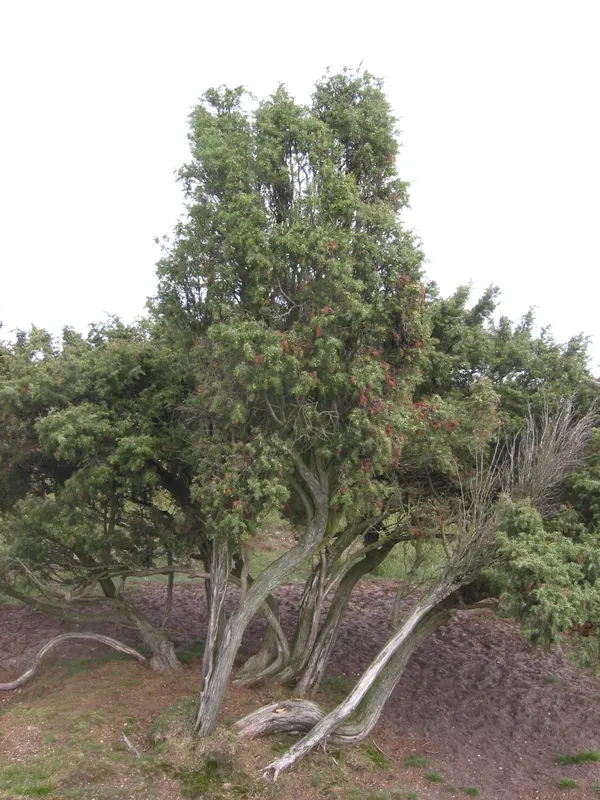
This plant carries serious safety risks. All information is for educational reference only.
Safety information
Toxicity: Serious with prolonged use/overdose — may cause renal damage (renal pain, urgency, painful urination, hematuria, albuminuria). | Juniper berry is a strong irritant diuretic; high/prolonged internal doses can cause kidney irritation. Some Juniperus species (e.g. J. sabina, savin) are abortifacient and toxic - species identity matters. | J. communis berry in small culinary amounts generally safe; large/prolonged medicinal doses (and essential oil) can irritate the kidneys (terpinen-4-ol/'renal irritant' concern). Several other Juniperus/Sabina species (e.g. savin, Juniperus sabina, rich in toxic podophyllotoxin-type sabinene) are toxic and abortifacient — not food.
Contraindications: People with kidney disease should not take juniper berries; avoid in pregnancy. | Pregnancy (abortifacient reputation across the genus); kidney disease/inflammation (book notes diuretics shouldn't be used long-term as they weaken liver/kidneys). | Pregnancy (emmenagogue/abortifacient reputation for strong juniper preparations and toxic relatives — avoid medicinal doses); kidney disease; the essential oil.
Interactions: None specifically reported. | Additive with diuretics; theoretical effect on lithium/electrolytes. (Safety gate.) | Possible additive effect with diuretics (and lithium clearance) and antidiabetic drugs.
Pregnancy & breastfeeding: Avoid in pregnancy. | Avoid (abortifacient reputation). | Avoid medicinal doses (emmenagogue/abortifacient reputation).
Evidence level
Supported by laboratory or animal studies; not yet confirmed in humans.
Preparations
This plant carries serious safety risks. All information is for educational reference only.
infusion · fruit (berry)
Part used: fruit (berry)
Traditional use: Traditionally used as a urinary antiseptic for cystitis, as a digestive bitter/carminative, and for rheumatism and arthritis (internally and externally).
How to prepare (traditional): Infusion: pour 1 cup of boiling water over 1 teaspoon of lightly crushed berries and infuse, covered, 20 minutes.
Dosage note (descriptive only): Drunk three times a day. Commission E: 2 g up to a maximum of 10 g dried fruit daily.
Reference only — not a dosage instruction
tincture · fruit (berry)
Part used: fruit (berry)
Traditional use: Diuretic / antiseptic.
How to prepare (traditional): Tincture at 1:5 in 40% alcohol.
Dosage note (descriptive only): 0.5-1 ml three times a day.
Reference only — not a dosage instruction
Associated conditions
Edibility
Edible parts: berry is a culinary spice (flavors gin); medicinal doses differ | J. communis berries used as a culinary spice in tiny amounts (game/gin flavour); not a food in quantity, and only confirmed J. communis. | ripe J. communis cones as a spice in small amounts only
Toxic lookalike warning
Never the toxic savin types (J. sabina); ensure species is J. communis. | CRITICAL: confirm Juniperus communis (three needle-like leaves in whorls, single white band above, soft ripe blue-black cone); do not gather other junipers/savin (J. sabina), which can be toxic and abortifacient (scale-like leaves, acrid smell).
Nutritional notes
Culinary spice. | Aromatic spice; negligible bulk nutrition.
Healing traditions
Related plants
Sources (3)
- Hoffmann D., Medical Herbalism (2003) — David Hoffmann (2003)
- ნუნუ ღლიღვაშვილი-მარგიანი, "მედეადან დღემდე" (Nunu Ghlighvashvili-margiani, "From Medea to the present day")
- Bussmann et al., A comparative ethnobotany ... Republic of Georgia, J Ethnobiol Ethnomed 2016;12:43