
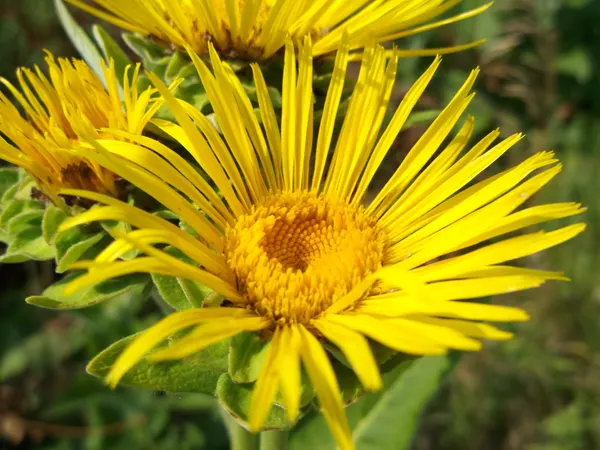
Safety information
Safety information
Toxicity: None serious noted by source. Modern: sesquiterpene lactones (alantolactone/helenin) can cause allergic contact dermatitis and, in large doses, GI irritation/vomiting; sensitization main concern. | Mild — can cause skin reactions. | May cause allergic reactions in Asteraceae-sensitive people. | Sesquiterpene lactones (alantolactone/isoalantolactone) can cause allergic contact dermatitis and, in large doses, GI/CNS upset (nausea, vomiting, cramping). | Mild-moderate caution. Sesquiterpene lactones can cause allergic contact dermatitis and, in large doses, GI irritation, vomiting, cramping. As Asteraceae, cross-allergy with ragweed/daisy family.
Contraindications: None specified by source. Modern: Asteraceae allergy; avoid in pregnancy. | Avoid internally in pregnancy/breastfeeding. | None specifically reported. | Pregnancy and breastfeeding (insufficient data; uterine caution); Asteraceae allergy; large doses; concurrent sedatives/antidiabetics (additive). | Pregnancy and breastfeeding (avoid — insufficient data / uterine caution); known Asteraceae (Compositae) allergy; not for young children at medicinal doses.
Interactions: None specified by source. | None specifically noted. | None reported. | Theoretical additive sedative/hypotensive and additive effect with antidiabetic drugs. | Theoretical additive effect with sedatives and antidiabetic agents — not verified as clinically significant. Cross-reactivity caution for those allergic to other Asteraceae.
Pregnancy & breastfeeding: Avoid (modern). | Avoid internally in pregnancy/breastfeeding. | Avoid (insufficient data; uterine caution). | Avoid — insufficient data / uterine caution.
Evidence level
Supported by laboratory or animal studies; not yet confirmed in humans.
Preparations
infusion · rhizome
Part used: rhizome
Traditional use: Traditionally used as an expectorant for irritating bronchial coughs (especially in children), bronchitis with copious catarrh, emphysema and asthma.
How to prepare (traditional): Cold-start infusion: pour 1 cup of cold water over 1 teaspoon of shredded root, let stand 8-10 hours, then heat and take very hot.
Dosage note (descriptive only): Taken very hot three times a day.
tincture · rhizome
Part used: rhizome
Traditional use: Expectorant.
How to prepare (traditional): Tincture at 1:5 in 40% alcohol.
Dosage note (descriptive only): 1-2 ml three times a day.
decoction · root
Part used: root
Traditional use: Traditionally taken for irritable coughs.
How to prepare (traditional): Decoction of the root (unearthed in autumn).
Dosage note (descriptive only): For irritable coughs, the book suggests about 1/3 cup (75 ml) two to three times a day.
tincture · root
Part used: root
Traditional use: Traditionally taken for bronchitis.
How to prepare (traditional): Tincture mixed with thyme tincture.
Dosage note (descriptive only): For bronchitis, the book suggests mixing 2 1/2 tbsp elecampane tincture with 2 1/2 tbsp thyme tincture, taken 1 tsp three times a day.
syrup · root
Part used: root
Traditional use: Traditionally taken for coughs.
How to prepare (traditional): Syrup made by reducing an infusion to half volume, then adding sugar or honey.
Dosage note (descriptive only): For coughs, the book suggests 1–2 tsp every 2 hours.
Associated conditions
Edibility
Edible parts: root historically candied/used as a condiment; richest natural source of inulin | root historically candied | historically candied root in tiny amounts; not a food | Limited — root historically candied as confectionery and used to flavor absinthe; not a routine food.
Toxic lookalike warning
The root superficially resembles belladonna (deadly nightshade) root, dandelion and marsh mallow roots - misidentifying a foraged root as belladonna could be fatal; do not forage roots by appearance. | As a wild-dug root, I. helenium (large yellow Asteraceae) could be confused with other large-leaved roots — misidentification of dug roots is a serious hazard; positive botanical ID mandatory.
Nutritional notes
Root very rich in inulin (fructan/prebiotic; up to ~44% in autumn). | Root rich in inulin (prebiotic), but used medicinally. | Inulin source (up to 44%). | Contains inulin (a prebiotic polysaccharide), but used medicinally not as food. | High in inulin (prebiotic fiber); not a significant nutritional food.
Healing traditions
Related plants
Sources (5)
- Grieve M., A Modern Herbal (1931) — Maud Grieve (1931)
- Chevallier A., Encyclopedia of Herbal Medicine (2016) — Andrew Chevallier (2016)
- Hoffmann D., Medical Herbalism (2003) — David Hoffmann (2003)
- Bussmann et al., A comparative ethnobotany ... Republic of Georgia, J Ethnobiol Ethnomed 2016;12:43
- Inula helenium — Wikipedia (cited to van Wyk & Wink 2004; EB 1911), 2025
Sourcing & resources
Affiliate links — we may earn a small commission at no extra cost to you.