
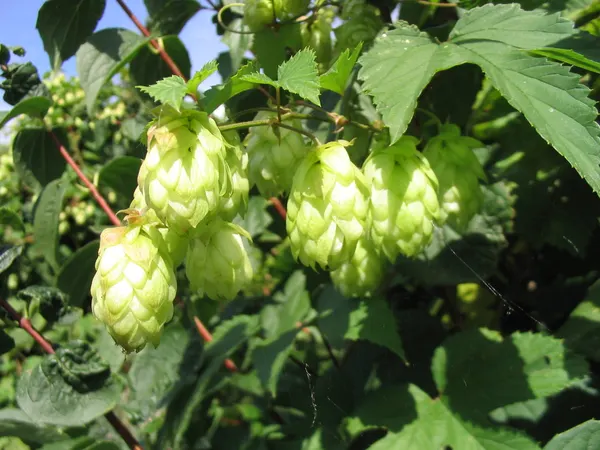
Safety information
Safety information
Toxicity: Mild. | Low; sedative, can cause drowsiness.
Contraindications: Avoid in depression (may deepen low mood). | Depression (hops can deepen low mood/sedation); pregnancy caution (phytoestrogenic - prenylflavonoids); before driving.
Interactions: Additive with sedatives (caution). | Additive sedation with CNS depressants/alcohol; phytoestrogen - theoretical caution with hormone-sensitive conditions/therapy. (Safety gate.)
Pregnancy & breastfeeding: Caution (phytoestrogenic).
Evidence level
Supported by laboratory or animal studies; not yet confirmed in humans.
Preparations
infusion · inflorescence (strobile)
Part used: inflorescence (strobile)
Traditional use: Traditionally used as a sedative/hypnotic for insomnia, tension and anxiety, and (astringent) for mucous colitis; externally for skin ulcers.
How to prepare (traditional): Infusion: pour 1 cup of boiling water over 1 teaspoon of dried herb and infuse, covered, 10-15 minutes; a cup taken at night to induce sleep (the dose may be strengthened if needed).
Dosage note (descriptive only): A cup at night for sleep. Commission E: 0.5 g dried herb as a single dose.
tincture · inflorescence (strobile)
Part used: inflorescence (strobile)
Traditional use: Sedative.
How to prepare (traditional): Tincture at 1:5 in 40% alcohol.
Dosage note (descriptive only): 1-4 ml three times a day.
other · flower
Part used: flower
Traditional use: Traditionally used to aid sleep.
How to prepare (traditional): Sachet made with dried strobiles (female flowers), placed inside a pillow.
Dosage note (descriptive only): The book suggests a sachet of about 100 g dried herb placed inside a pillow.
infusion · flower
Part used: flower
Traditional use: Traditionally taken for insomnia.
How to prepare (traditional): Infusion of the strobiles.
Dosage note (descriptive only): For insomnia, the book suggests about 3/4 cup (150 ml) at night.
tincture · flower
Part used: flower
Traditional use: Traditionally taken for anxiety and digestive headaches.
How to prepare (traditional): Tincture diluted in water.
Dosage note (descriptive only): For excessive anxiety, the book suggests 20 drops in a glass of water three times a day; for digestive headaches, 10 drops with water up to 6 times a day.
powder · flower
Part used: flower
Traditional use: Traditionally taken to stimulate appetite.
How to prepare (traditional): Capsules made from powder.
Dosage note (descriptive only): To stimulate the appetite, the book suggests a 300 mg capsule twice a day before meals.
Associated conditions
Edibility
Edible parts: used to flavour beer; young shoots eaten as a vegetable in some cuisines | Young hop shoots are eaten as a vegetable in some traditions (not in this book); cones are a flavouring/medicinal, not a food.
Nutritional notes
Bitter; minor.
Healing traditions
Related plants
Sources (2)
- Chevallier A., Encyclopedia of Herbal Medicine (2016) — Andrew Chevallier (2016)
- ნუნუ ღლიღვაშვილი-მარგიანი, "მედეადან დღემდე" (Nunu Ghlighvashvili-margiani, "From Medea to the present day")
Sourcing & resources
Affiliate links — we may earn a small commission at no extra cost to you.