
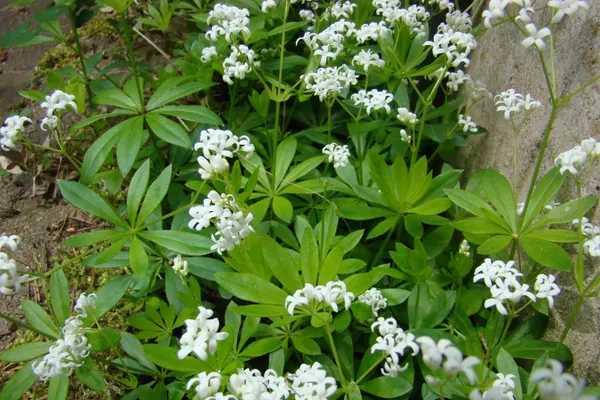
Sweet woodruff
Galium odoratum
Other names: Woodruff, master of the wood, Asperula odorata (syn.), Waldmeister
Edible plantPhoto credit: Hajotthu / Wikimedia Commons
Safety information
Safety information
Toxicity: Mild at culinary/flavoring amounts. Contains coumarin; large or prolonged intake may cause headache, dizziness, and (theoretically) liver effects; coumarin was restricted in German food use (1974). Not hydroxycoumarin — culinary woodruff is not a clinically significant anticoagulant, but high-dose extracts should be avoided.
Contraindications: Pregnancy/lactation; liver disease; avoid high-dose/prolonged use.
Interactions: Theoretical additive sedation with CNS depressants; caution with hepatotoxic drugs at high doses; not a meaningful warfarin interaction at culinary doses but avoid concentrated extracts with anticoagulants out of caution.
Pregnancy & breastfeeding: Avoid in pregnancy/lactation.
Evidence level
Documented in systematic traditional medicine literature.
Preparations
infusion · aerial parts
Part used: aerial parts
Traditional use: mild sedative/antispasmodic for sleep, nervous tension, minor spasms
Proposed mechanism: coumarin (aroma); mild sedative
Dosage note (descriptive only): keep to culinary amounts; avoid high-dose/prolonged use
edible · aerial parts
Part used: aerial parts
Traditional use: flavoring (e.g. May wine)(Folk and historical sources have not been validated by clinical research.)
Proposed mechanism: coumarin aroma
Dosage note (descriptive only): small amounts only
Associated conditions
Edibility
Edible parts: leaves used in small amounts to flavor drinks/desserts (raw, dried/wilted)
Toxic lookalike warning
Other bedstraws (Galium spp.) are similar; harvest the fragrant, whorled-leaf G. odoratum, and never confuse with unrelated white-flowered umbellifers when foraging shaded woodland
Nutritional notes
Not a significant nutrient source; aromatic flavoring only
Healing traditions
Related plants
Sources (3)
- Galium odoratum — Wikipedia (EN)
- Phenolic Content and Anti-Inflammatory Activity of … Galium odoratum (PMC, 2024)
- Woodruff, Sweet — Drugs.com / Review of Natural Products (EN)
Sourcing & resources
Affiliate links — we may earn a small commission at no extra cost to you.