
Safety information
Safety information
Toxicity: Mild — can occasionally cause photosensitivity; rare allergy; restricted in some countries. | Mild; rare hepatotoxicity reports with oral extracts; contact dermatitis (topical); drowsiness at high oral doses.
Contraindications: Photosensitivity caution; caution in pregnancy. | Pregnancy (avoid); hepatic disease (history of herb-induced liver injury); before surgery (sedative).
Interactions: None specifically noted. | Sedatives (additive CNS depression), known/suspected hepatotoxic drugs (theoretical additive), antidiabetic/cholesterol-lowering drugs.
Pregnancy & breastfeeding: Caution in pregnancy. | Avoid.
Evidence level
Supported by clinical trials in humans.
Preparations
powder · aerial parts
Part used: aerial parts
Traditional use: As a general tonic.
How to prepare (traditional): Powder, an important Ayurvedic remedy, taken with water.
Dosage note (descriptive only): Take 1–2 g a day with water as a general tonic.
other · aerial parts
Part used: aerial parts
Traditional use: Applied to eczema.
How to prepare (traditional): Paste made from the powder: mix 2 tsp powder with 5 tsp (25 ml) water.
Dosage note (descriptive only): Apply to patches of eczema.
infusion · aerial parts
Part used: aerial parts
Traditional use: For rheumatism.
How to prepare (traditional): Infusion of the aerial parts.
Dosage note (descriptive only): For rheumatism, take about 7 tsp twice a day.
tincture · aerial parts
Part used: aerial parts
Traditional use: For poor memory and concentration.
How to prepare (traditional): Tincture of the aerial parts.
Dosage note (descriptive only): For poor memory and concentration, take 40 drops with water 3 times a day.
Associated conditions
Edibility
Edible parts: leaves eaten fresh in Indian salads/as a vegetable | Young leaves eaten raw or cooked (salads, juices) in South/Southeast Asian cuisine.
Toxic lookalike warning
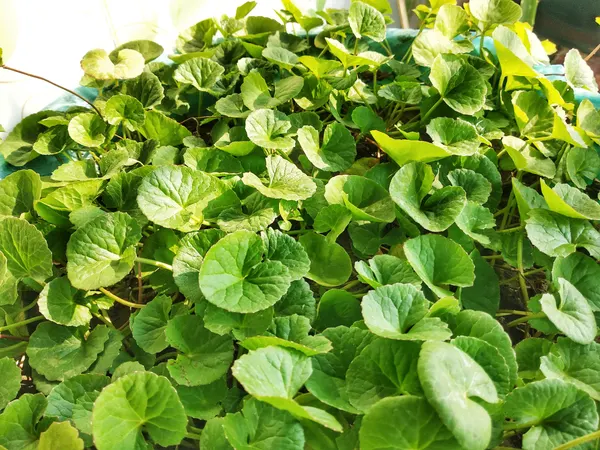
As a low creeping wetland plant it can be confused with pennyworts and other marsh creepers — positively ID before eating wild material. | Low-growing creeping plants easily confused; Hydrocotyle spp. and other pennyworts, and marsh weeds, can be mistaken for it. Misidentification and contaminated water sources are real risks — do not wild-forage without expert ID.
Nutritional notes
Leafy green; bittersweet tonic. | Leaves provide vitamin C, carotenoids, minerals; functional-food/leafy-green role. Bioactives: asiaticoside, madecassoside.
Healing traditions
Related plants
Sources (5)
- Chevallier A., Encyclopedia of Herbal Medicine (2016) — Andrew Chevallier (2016)
- Wright 2022, Antioxidants (PMID 35204098)
- Wattanathorn 2008, J Ethnopharmacol (PMID 18191355)
- Bandopadhyay 2023, J Cell Mol Med (PMID 36756687)
- Gohil 2010, Indian J Pharm Sci (PMID 21694984)
Sourcing & resources
Affiliate links — we may earn a small commission at no extra cost to you.