
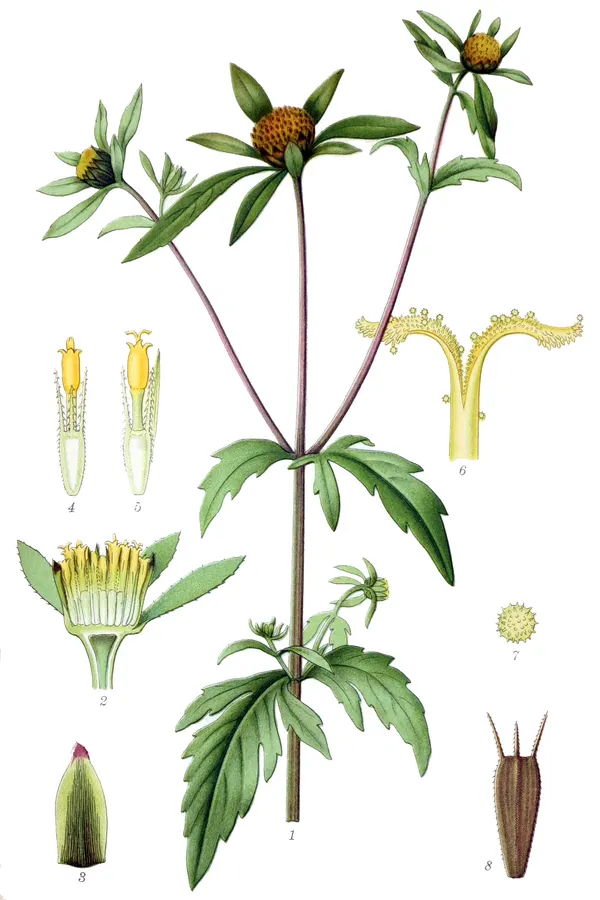
Cherada / Three-part beggarticks
Bidens tripartita
Photo credit: Mentz, August, 1867-1944 & Ostenfeld, C. H. (Carl Hansen), 1873-1931
Safety information
Safety information
Toxicity: Mild. Topical/bath use generally low-risk for correctly identified plant.
Contraindications: Internal use in pregnancy/lactation and in infants unstudied (external/bath use is the traditional paediatric form, but only on intact skin); possible Asteraceae sensitisation.
Interactions: None well-characterised.
Pregnancy & breastfeeding: Internal use in pregnancy/lactation unstudied.
Evidence level
Supported by laboratory or animal studies; not yet confirmed in humans.
Preparations
bath/wash · flowering herb
Part used: flowering herb
Dosage note (descriptive only): only on intact skin
infusion (tea) · flowering herb
Part used: flowering herb
Traditional use: paediatric skin baths/wash for infant rashes, 'diathesis'/atopic skin, eczema and seborrhoea, 'blood-cleansing'/diuretic tea
Proposed mechanism: flavonoids (luteolin, butein-type chalcones), polyacetylenes, carotenoids, tannins — antimicrobial/anti-inflammatory
Associated conditions
Nutritional notes
Not a food source.
Healing traditions
Related plants
Sources (1)
- Bolatkyzy et al. 2025, Molecules (medicinal-plants-for-skin-disorders review)
Sourcing & resources
Affiliate links — we may earn a small commission at no extra cost to you.