
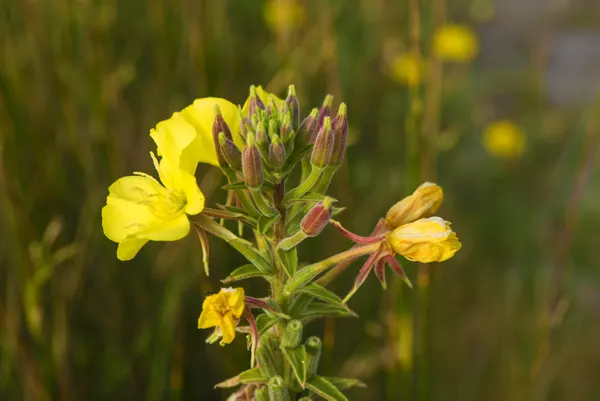
Evening Primrose
Oenothera biennis
Other names: Evening Primrose, Evening primrose
Edible plantPhoto credit: Christian Ferrer
Safety information
Safety information
Toxicity: Generally mild - GI upset, headache. Possible increased bleeding and (debated) lowered seizure threshold. | Root/leaf low toxicity. Seed-oil supplement: generally mild GI effects; bleeding/seizure-threshold cautions discussed for supplements (separate from food).
Contraindications: Caution before surgery (bleeding); epilepsy/seizure disorders (theoretical/debated seizure-threshold concern), and historically cautioned with phenothiazine antipsychotics. Limited pregnancy data. | Seed-oil supplements: caution with anticoagulants and in epilepsy (theoretical). Food root: none well established.
Interactions: May increase bleeding with anticoagulants/antiplatelets; debated interaction lowering seizure threshold (caution with epileptogenic drugs) - consult provider. | Seed oil — theoretical additive antiplatelet; possible lowering of seizure threshold with phenothiazines (supplement context).
Pregnancy & breastfeeding: Limited pregnancy data.
Evidence level
Supported by clinical trials in humans.
Preparations
cooked · first-year root
Part used: first-year root
Traditional use: boiled, peppery/parsnip-like(Folk and historical sources have not been validated by clinical research.)
cooked · young leaf
Part used: young leaf
Traditional use: potherb(Folk and historical sources have not been validated by clinical research.)
pressed oil (supplement) · seed
Part used: seed
Traditional use: GLA oil for eczema/PMS (separate, mixed evidence)
Proposed mechanism: gamma-linolenic acid
seed-oil capsule (oral) / topical oil · seed oil
Part used: seed oil
Traditional use: eczema/atopic dermatitis, premenstrual syndrome, breast pain (mastalgia), menopausal symptoms, diabetic neuropathy
Proposed mechanism: provides GLA, a precursor to anti-inflammatory eicosanoids (dihomo-gamma-linolenic acid to series-1 prostaglandins); proposed essential-fatty-acid mechanism has not translated to consistent clinical benefit
Dosage note (descriptive only): trials used varied doses of EPO providing GLA (capsules totalling a few grams of oil/day); trial regimen, descriptive only
Associated conditions
Edibility
Edible parts: Roots and young parts were eaten by some Indigenous peoples, but the oil is the modern product, not a food per se. | First-year taproot cooked; young leaves cooked.
Toxic lookalike warning
Whole-plant foraging requires positive ID. | First-year rosettes confused with foxglove (Digitalis, lethal) and other rosettes; evening primrose has a pinkish midrib and lance leaves, often a flat rosette — confirm by the second-year tall yellow four-petalled flower and absence of foxglove's hairy netted leaves before eating roots.
Nutritional notes
Oil is a source of GLA (omega-6); not a staple food. | Root provides starch/fibre and minerals; seed oil is a source of GLA (gamma-linolenic acid), an omega-6 functional fatty acid.
Healing traditions
Related plants
Sources (4)
- NCCIH/Cochrane evening primrose (atopic eczema) evidence
- MedlinePlus evening primrose oil information
- NCCIH evening primrose oil information
- ethnobotanical food references for Oenothera biennis
Sourcing & resources
Affiliate links — we may earn a small commission at no extra cost to you.