
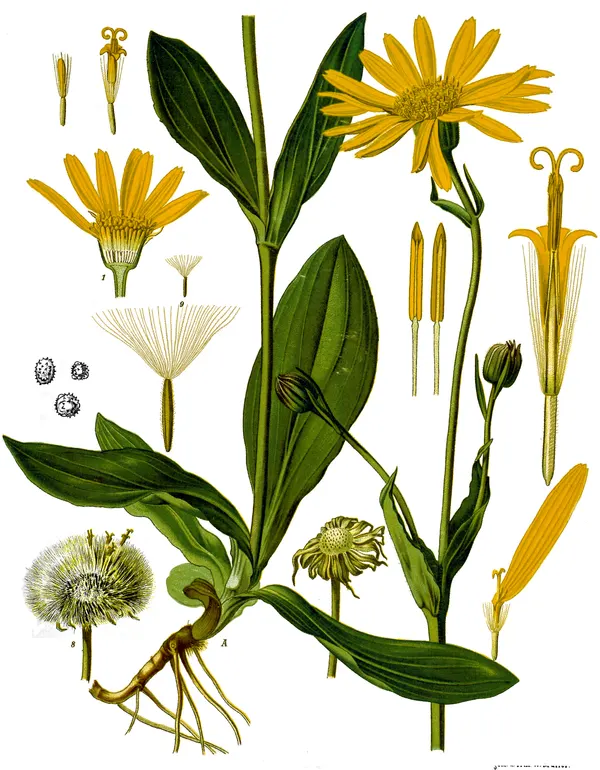
Arnica
Arnica montana
Other names: Arnica
Photo credit: Franz Eugen Köhler, Köhler's Medizinal-Pflanzen
This plant carries serious safety risks. All information is for educational reference only.
Safety information
Toxicity: Serious — sesquiterpene lactones are toxic; oral use must be avoided. Topical use may cause allergic skin reactions.
Contraindications: Do NOT take internally (except properly prepared homeopathic dilutions); do not apply to broken skin.
Interactions: None specifically reported.
Evidence level
Supported by laboratory or animal studies; not yet confirmed in humans.
Preparations
This plant carries serious safety risks. All information is for educational reference only.
tincture · flower head
Part used: flower head
Traditional use: Traditionally used externally for bruises, sprains and local pain/inflammation on unbroken skin; the book states it must NOT be taken internally (the herbal form). Homeopathic preparations are a separate matter.
How to prepare (traditional): EXTERNAL USE ONLY. A folk tincture is made by pouring about 1 pint (0.5 L) of 70% alcohol over 50 g of freshly picked flowers in a clear glass container, sealing, and standing at least a week in the sun or a warm place; filter and store away from light. Applied only to unbroken skin.
Dosage note (descriptive only): professional use only - not provided
Reference only — not a dosage instruction
Associated conditions
Healing traditions
Related plants
Sources (1)
- Hoffmann D., Medical Herbalism (2003) — David Hoffmann (2003)