
Safety information
Safety information
Toxicity: Fruit generally very safe (a common food). Bilberry LEAF preparations not recommended for prolonged/high-dose use (hydroquinone and possible hepatic/hypoglycaemic effects) - the fruit is the food/medicinal part. | None known. | None known as food. | Berries: none known as food. Leaf taken long-term/high-dose not recommended (hydroquinone-type and tannin concerns in related taxa; possible hepatic stress). | None known for fruit at food/traditional doses; EMA reported no side effects. Leaf in large/prolonged doses cautioned against (not part of EMA fruit monograph).
Contraindications: Fruit: none notable as a food. Diabetic patients using leaf/extracts: monitor glucose. Limited pregnancy data for concentrated extracts. | If on anticoagulants or with a bleeding disorder, take medicinal doses only on professional advice. | None for food amounts. | Diabetics using the leaf 'for sugar' should monitor for additive hypoglycaemia; medicinal leaf preparations not for pregnancy without advice; avoid prolonged high-dose leaf use. | EMA fresh-fruit medicine adults only, max 4 weeks; consult doctor if symptoms persist >2 weeks. Not studied as a medicine in pregnancy (culinary fruit is food).
Interactions: High-dose extracts: theoretical additive effect with anticoagulants/antiplatelets and antidiabetics - consult provider. | Anticoagulants (consult professional). | Theoretical mild hypoglycaemic at very high intake; minor. (Safety gate.) | Theoretical additive effect with antidiabetic and antiplatelet drugs (anthocyanins/leaf). | None established at food doses. Theoretical caution with antidiabetic drugs (folk leaf-tea hypoglycaemic reputation) and anticoagulants (anthocyanin antiplatelet activity) — not verified as clinically significant.
Pregnancy & breastfeeding: Limited pregnancy data for concentrated extracts. | Not noted. | Medicinal leaf preparations not for pregnancy without advice. | Not studied as a medicine in pregnancy (culinary fruit is food).
Evidence level
Supported by clinical trials in humans.
Preparations
capsule · fruit
Part used: fruit
Traditional use: To improve eye circulation.
How to prepare (traditional): Fruit extract is made into capsules.
Dosage note (descriptive only): Up to 4 x 500 mg capsules a day to improve circulation within the eye.
tincture · fruit
Part used: fruit
Traditional use: For poor circulation.
How to prepare (traditional): A tincture is made from the fruit.
Dosage note (descriptive only): About 1/2 tsp a day for poor circulation.
decoction · fruit
Part used: fruit
Traditional use: Short-term treatment of childhood diarrhea.
How to prepare (traditional): A pleasant-tasting decoction is made from the berries.
Dosage note (descriptive only): For short-term treatment of diarrhea in children.
Associated conditions
Edibility
Edible parts: ripe berries, raw or cooked (jams, desserts), a traditional wild food | berries are a nutritious edible fruit | Ripe berries (raw/cooked). | ripe berries raw or cooked | Ripe berries, raw or cooked (jam, syrup, tea).
Toxic lookalike warning
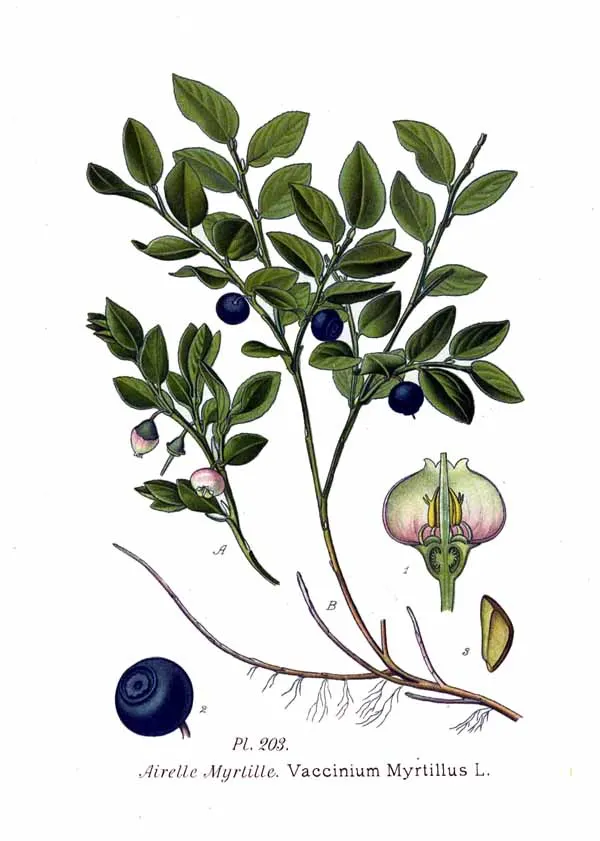
Wild Vaccinium berries generally safe, but foragers must positively distinguish dark wild berries from unrelated toxic black/blue berries (e.g., deadly nightshade Atropa belladonna berries, buckthorn) before eating. | Distinguish from inedible/toxic dark berries (e.g. deadly nightshade berries grow on a soft non-shrubby plant) — bilberry is a low woody shrub with small round blue-black berries. | Confirm true Vaccinium (small dark-blue berry, low shrub of acid soils/mountains); avoid confusing dark berries with toxic look-alikes such as deadly nightshade berries (Atropa - larger, shiny black, on a different plant) or buckthorn. | Small dark-blue/black wild berries are a high-risk group for beginners; confirm true Vaccinium (low shrub, single berries with a crown/calyx scar, staining purple juice); never gather unknown dark berries, some of which (e.g. deadly nightshade Atropa, buckthorn) are toxic. | Low lookalike risk (mainly confused with other harmless Vaccinium/blueberries). General foraging caution: avoid confusing dark berries with toxic species (e.g. deadly nightshade) in mixed habitats.
Nutritional notes
Functional food - anthocyanins, vitamin C, manganese, fibre; low calorie. | Anthocyanin/proanthocyanin antioxidants; vitamin C; functional superfruit. | Anthocyanins, vitamin C, manganese; classic 'eyesight' folk berry (anthocyanin content). | Anthocyanins, vitamin C, vitamin E, manganese, fibre; among the highest-anthocyanin temperate fruits. | Rich in anthocyanins, vitamin C, tannins, flavonoids; functional-food antioxidant.
Healing traditions
Related plants
- Daruharidra (tree turmeric / Indian barberry)Berberis aristataClinical
- Musta (nutgrass)Cyperus rotundusClinical
- Khadira (black catechu / cutch tree)Acacia catechuClinical
- Kalgan / TormentilPotentilla erectaClinical
- Sangre de grado / Dragon's bloodCroton lechleriClinical
- Amur cork tree bark / huang bai (黄柏)Phellodendron amurenseClinical
Sources (7)
- Chevallier A., Encyclopedia of Herbal Medicine (2016) — Andrew Chevallier (2016)
- ნუნუ ღლიღვაშვილი-მარგიანი, "მედეადან დღემდე" (Nunu Ghlighvashvili-margiani, "From Medea to the present day")
- Bussmann et al., A comparative ethnobotany ... Republic of Georgia, J Ethnobiol Ethnomed 2016;12:43
- Bussmann et al., Unity in diversity — food plants of Sakartvelo, 2021
- EMA/HMPC Myrtilli fructus (bilberry fruit) monograph & public summary
- Myrtilli fructus recens — HMPC summary, EMA/HMPC, 2015
- Final EU herbal monograph on Vaccinium myrtillus L., fructus recens (EMA/HMPC/375808/2014), 2015
Sourcing & resources
Affiliate links — we may earn a small commission at no extra cost to you.