
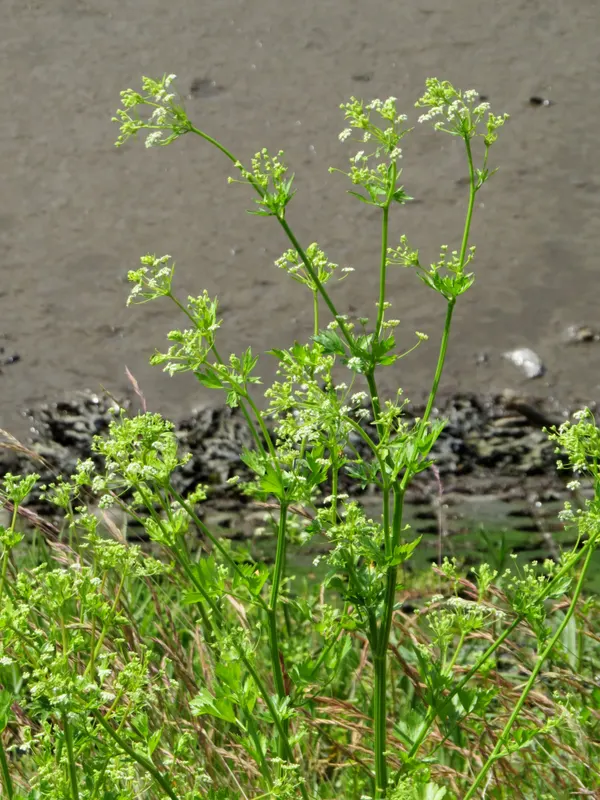
Celery
Apium graveolens
Other names: Celery, Celery Seed
Edible plantPhoto credit: MPF (Wikimedia Commons)
Safety information
Safety information
Toxicity: Mild — furanocoumarins (bergapten) can photosensitize skin. | Photosensitivity reactions from external contact with celery stems (furanocoumarins).
Contraindications: Avoid celery seed in pregnancy or with kidney disease; do not use seed sold for cultivation; essential oil internal use professional-only. | None specifically reported beyond photosensitivity.
Interactions: Photosensitizer — caution with sun exposure. | None specifically reported.
Pregnancy & breastfeeding: Avoid celery seed in pregnancy.
Evidence level
Supported by laboratory or animal studies; not yet confirmed in humans.
Preparations
infusion · seed
Part used: seed
Traditional use: Traditionally used for rheumatism, arthritis and gout (mainly via its diuretic action) and as a urinary antiseptic.
How to prepare (traditional): Infusion: pour 1 cup of boiling water over 1-2 teaspoons of freshly crushed seeds and infuse, covered, 10-15 minutes.
Dosage note (descriptive only): Drunk three times a day.
tincture · seed
Part used: seed
Traditional use: Antirheumatic.
How to prepare (traditional): Tincture at 1:5 in 60% alcohol.
Dosage note (descriptive only): 1-4 ml three times a day.
other · seed
Part used: seed
Traditional use: As a cleansing drink.
How to prepare (traditional): Organic carrot and celery juice as a cleansing drink.
Dosage note (descriptive only): Take 3/4 cup (150 ml) of organic carrot and celery juice a day.
powder · seed
Part used: seed
Traditional use: For arthritis.
How to prepare (traditional): Powder of the seeds mixed with food.
Dosage note (descriptive only): For arthritis, mix 1 tsp with food each day.
Associated conditions
Edibility
Edible parts: stems eaten raw/cooked; seeds a culinary spice; celeriac is related edible root | celery is a food plant; seed is a culinary spice
Toxic lookalike warning
Wild celery and other umbellifers resemble deadly poison hemlock (Conium) and hemlock water-dropwort — never forage umbellifers without expert ID.
Nutritional notes
Low-calorie vegetable; cleansing juice with carrot is a traditional functional drink. | Culinary aromatic.
Healing traditions
Related plants
Sources (2)
- Chevallier A., Encyclopedia of Herbal Medicine (2016) — Andrew Chevallier (2016)
- Hoffmann D., Medical Herbalism (2003) — David Hoffmann (2003)
Sourcing & resources
Affiliate links — we may earn a small commission at no extra cost to you.