
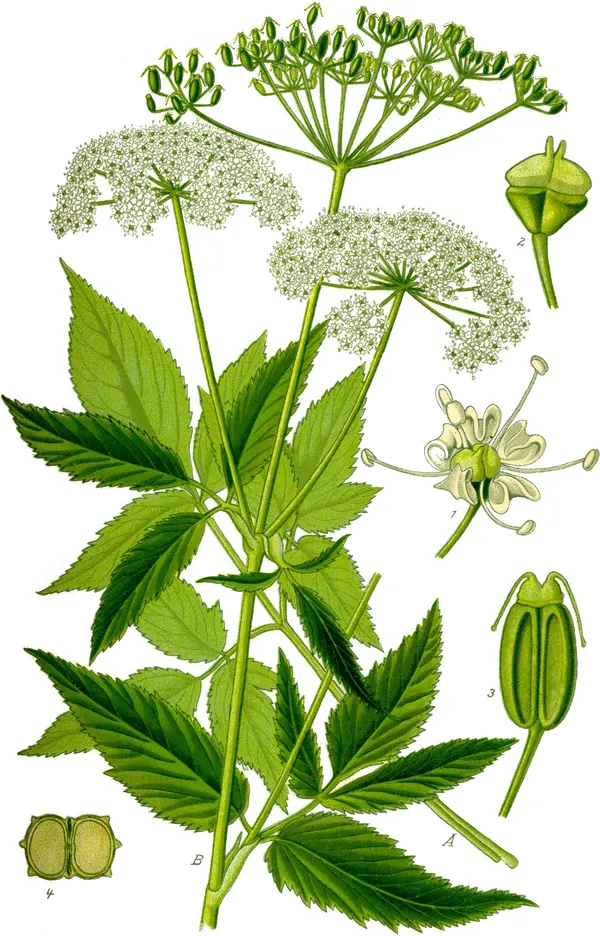
Snyt / Ground elder (goutweed)
Aegopodium podagraria
Edible plantPhoto credit: Otto Wilhelm Thomé
Safety information
Safety information
Toxicity: None known at food amounts for correctly identified plant.
Contraindications: None specific at culinary amounts; medicinal teas in pregnancy/lactation unstudied (caution).
Interactions: None well-characterised.
Pregnancy & breastfeeding: Medicinal teas in pregnancy/lactation unstudied — caution.
Evidence level
Reported in folk medicine sources; not clinically validated. Folk and historical sources have not been validated by clinical research.
Preparations
infusion/poultice (folk) · herb
Part used: herb
edible-raw (young leaves), cooked (soups, 'snyt' shchi') · young leaves/shoots
Part used: young leaves/shoots
Traditional use: spring wild-food; folk for gout/rheumatism and joint pain (poultice and tea), mild diuretic(Folk and historical sources have not been validated by clinical research.)
Proposed mechanism: nutritional (vitamin C, minerals, carotenoids) green; anti-inflammatory folk reputation has only limited preclinical support
Associated conditions
Edibility
Edible parts: Young leaves and shoots, raw in salads or cooked in soups/like spinach (a prized spring green).
Toxic lookalike warning
Critical — Apiaceae family: never harvest umbellifers without certain ID — deadly poison hemlock (Conium maculatum) and hemlock water-dropwort (Oenanthe crocata) can grow nearby and are lethal. Aegopodium has a distinctive grooved triangular leaf-stalk and 3x3 (ternate) leaf division and no purple-blotched stem; if unsure, do not eat.
Nutritional notes
Vitamin C, carotene, minerals; valued early-spring leafy green.
Healing traditions
Related plants
Sources (1)
- Gonzalez Carretero et al. 2026, PLoS One (PMC12959656)
Sourcing & resources
Affiliate links — we may earn a small commission at no extra cost to you.