
This plant carries serious safety risks. All information is for educational reference only.
Safety information
Toxicity: Mild — berries are not for eating raw. | None known reported. | Raw unripe fruit and the seeds are mildly toxic/emetic (saponins, viburnin); only ripe (post-frost) fruit is eaten, and even then in moderation.
Contraindications: None specifically noted. | None specifically named. | Pregnancy (uterotonic folk use - the book's own 'uterine tone' recipes); kidney stones/gout (oxalates).
Interactions: None specifically noted. | None reported. | Theoretical additive with antihypertensives/diuretics; uterotonic caution. (Safety gate.)
Pregnancy & breastfeeding: Used to protect against threatened miscarriage (uterine relaxant). | Avoid (uterotonic).
Evidence level
Documented in systematic traditional medicine literature.
Preparations
This plant carries serious safety risks. All information is for educational reference only.
tincture · bark
Part used: bark
Traditional use: For muscular tension and IBS.
How to prepare (traditional): A tincture is made from the bark, used for long-term treatment of muscular tension.
Dosage note (descriptive only): For irritable bowel syndrome, 1/2 tsp diluted with hot water twice a day.
Reference only — not a dosage instruction
decoction · bark
Part used: bark
Traditional use: For menstrual/period pain.
How to prepare (traditional): A decoction is made from the bark.
Dosage note (descriptive only): For period pain, about 1/3 cup (75 ml) every 3 hours.
Reference only — not a dosage instruction
lotion · bark
Part used: bark
Traditional use: Relieves aching muscles (external).
How to prepare (traditional): A lotion is made and rubbed into tense neck and shoulders.
Dosage note (descriptive only): Rub into aching muscles as needed.
Reference only — not a dosage instruction
Associated conditions
Edibility
Edible parts: berries edible only when cooked (raw can cause GI upset) | Ripe fruit only, usually cooked (jelly/preserve); bitter.
Toxic lookalike warning
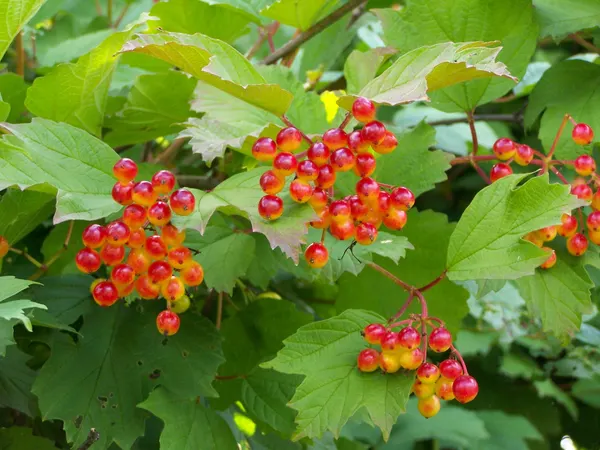
Raw berries are mildly toxic/unpalatable (sometimes cooked into preserves elsewhere) — treat as not edible without proper preparation. | Ripe Viburnum opulus (red translucent drupes, maple-like lobed leaves, flat-topped flower cluster) can be confused with other red shrub berries - confirm ID; never eat unripe/green berries.
Nutritional notes
Not a food. | Vitamin C, organic acids, pectin (ripe fruit).
Healing traditions
Related plants
Sources (3)
- Chevallier A., Encyclopedia of Herbal Medicine (2016) — Andrew Chevallier (2016)
- Hoffmann D., Medical Herbalism (2003) — David Hoffmann (2003)
- ნუნუ ღლიღვაშვილი-მარგიანი, "მედეადან დღემდე" (Nunu Ghlighvashvili-margiani, "From Medea to the present day")