
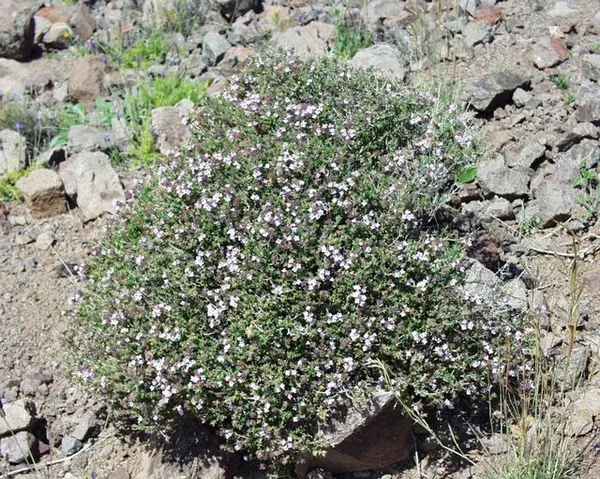
Thyme
Thymus vulgaris
Other names: Thyme, Thyme (Garden Thyme)
Edible plantPhoto credit: Henry Brisse (upload by user:Abalg )
Safety information
Safety information
Toxicity: May cause stomach problems. Concentrated essential oil (thymol) is irritant and not for undiluted ingestion. | Culinary herb and tea are safe. Concentrated thyme oil/thymol is a potent phenol - irritant to skin/mucous membranes and toxic in large internal doses; not for casual undiluted internal use. | Mild — essential oil is strong (not for unsupervised internal use; not externally in pregnancy). | None known reported (for the herb; concentrated thymol oil is irritant generally). | Culinary amounts safe. Concentrated thymol oil is irritant; high medicinal doses cautioned.
Contraindications: Must NOT be used by those allergic to thyme or other Lamiaceae (Labiatae). EMA: mostly >12; some preparations >4 years. | None specified by source. Modern: avoid large doses of oil in pregnancy. | Essential oil professional-only internally; avoid topical oil in pregnancy. | None specifically reported. | Pregnancy (medicinal/oil amounts); thymol oil not for undiluted use.
Interactions: None stated on public summary. | None specified by source. | None specifically noted. | None reported. | Theoretical antiplatelet at high oil doses.
Pregnancy & breastfeeding: Not specifically addressed. | Avoid large doses of oil (modern). | Avoid topical essential oil in pregnancy. | Pregnancy (medicinal/oil amounts).
Evidence level
Supported by clinical trials in humans.
Preparations
infusion · aerial parts
Part used: aerial parts
Traditional use: Respiratory remedy for colds and chest infections.
How to prepare (traditional): An infusion is made from the aerial parts.
Dosage note (descriptive only): For colds, 1/2 cup (100 ml) three times daily.
syrup · aerial parts
Part used: aerial parts
Traditional use: Traditional cough remedy.
How to prepare (traditional): A syrup is made, a traditional cough remedy.
Dosage note (descriptive only): 1 tbsp three times a day.
tincture · aerial parts
Part used: aerial parts
Traditional use: Applied for thrush/fungal infection.
How to prepare (traditional): A tincture is made from the aerial parts.
Dosage note (descriptive only): For thrush, apply 40 drops, 2-3 times daily.
oil · aerial parts
Part used: aerial parts
Traditional use: Applied externally to acne (not for internal use).
How to prepare (traditional): The essential oil is diluted to 5% and dabbed onto inflamed spots.
Dosage note (descriptive only): Diluted to 5% for external use on acne.
Associated conditions
Edibility
Edible parts: leaves/flowering tops as a culinary herb (fresh/dried), raw or cooked | leaves widely culinary (cooked) and as tea | common culinary herb (leaves) | culinary herb (leaf) | Leaf as culinary herb.
Toxic lookalike warning
Cultivated; unmistakable by aroma. | Garden/wild thymes are aromatic and edible; never consume small leathery-leaved shrubs unless confirmed by the characteristic thyme scent. | Culinary thyme a known cultivated herb; wild thyme (Thymus serpyllum) similarly aromatic — confirm mint-family thyme scent; not generally confused with toxic plants.
Nutritional notes
Culinary herb; negligible quantities, rich in volatile oils (thymol). | Culinary herb; oil rich in thymol and carvacrol (20-25%+), plus cymene, pinene, borneol, linalol. | Antioxidant culinary herb. | Culinary aromatic. | Thymol, carvacrol, rosmarinic acid, vitamin K, iron (dried); functional antioxidant/antimicrobial herb.
Healing traditions
Related plants
Sources (6)
- Grieve M., A Modern Herbal (1931) — Maud Grieve (1931)
- Chevallier A., Encyclopedia of Herbal Medicine (2016) — Andrew Chevallier (2016)
- Hoffmann D., Medical Herbalism (2003) — David Hoffmann (2003)
- EMA/HMPC Thymi herba monograph & public summary
- EMA/HMPC Thymi herba
- food-composition literature
Sourcing & resources
Affiliate links — we may earn a small commission at no extra cost to you.