
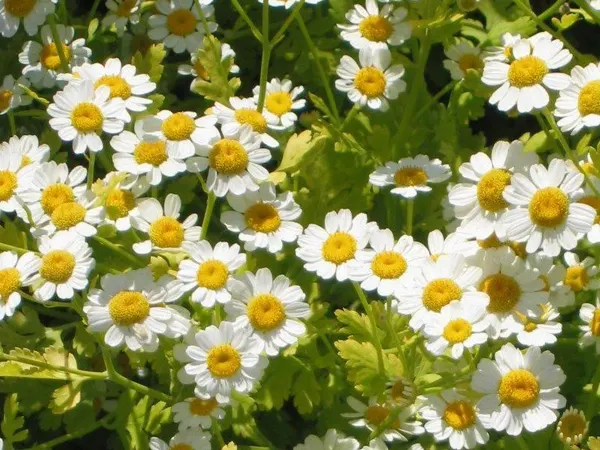
This plant carries serious safety risks. All information is for educational reference only.
Safety information
Toxicity: No serious effects reported; nausea, bloating, GI symptoms. Chewing fresh leaves can cause mouth ulcers/irritation; topical contact can cause dermatitis. | Generally mild. Modern: chewing fresh leaves can cause mouth ulcers/oral irritation; contact dermatitis (Asteraceae); abrupt discontinuation may cause rebound symptoms. | Mild — chewing fresh leaves can cause mouth ulcers; rare allergy. | May cause allergic response in Asteraceae-sensitive people; fresh leaves can cause mouth ulcers in susceptible people.
Contraindications: Ragweed/Asteraceae cross-allergy. Do NOT use in pregnancy (uterine-contraction concern). Stop >=2 weeks before surgery (slows clotting). Abrupt discontinuation after long use may cause rebound headache (post-feverfew syndrome). | None specified by source. Listed as an emmenagogue. Modern: avoid in pregnancy and in Asteraceae allergy. | Avoid in pregnancy; do not use with warfarin/blood thinners. | Should not be used in pregnancy (stimulant action on the uterus).
Interactions: May interact with anticoagulants/antiplatelets and some migraine medications. | None specified by source. Modern: may affect platelets - caution with anticoagulants/antiplatelets. | Warfarin and other anticoagulants (contraindicated). | Theoretically may interfere with aspirin and other anticoagulant medications.
Pregnancy & breastfeeding: Do NOT use in pregnancy (uterine-contraction/abortifacient concern). | Avoid (emmenagogue) (modern). | Avoid in pregnancy. | Should not be used in pregnancy (uterine stimulant).
Evidence level
Supported by clinical trials in humans.
Preparations
This plant carries serious safety risks. All information is for educational reference only.
other · leaf
Part used: leaf
Traditional use: Traditionally eaten to prevent migraine.
How to prepare (traditional): Fresh leaves are eaten, traditionally on a piece of bread.
Dosage note (descriptive only): To prevent migraine, 2-3 leaves daily.
Reference only — not a dosage instruction
tincture · aerial parts
Part used: aerial parts
Traditional use: Long-term migraine prevention.
How to prepare (traditional): A tincture is made from the aerial parts.
Dosage note (descriptive only): For long-term migraine prevention, about 10 drops a day.
Reference only — not a dosage instruction
capsule · aerial parts
Part used: aerial parts
Traditional use: Symptomatic relief of headaches.
How to prepare (traditional): Capsules are made; tablets often contain other herbs.
Dosage note (descriptive only): For symptomatic relief of headaches, a 100 mg capsule daily.
Reference only — not a dosage instruction
Associated conditions
Edibility
Edible parts: Leaves chewed traditionally but irritating - not recommended as food. | strongly bitter medicinal herb; chewing raw can ulcerate the mouth | Leaves taken (2–3/day on bread for migraine) but can cause mouth ulcers — not a general food
Toxic lookalike warning
Avoid confusing with other daisy-family plants.
Nutritional notes
Not relevant. | Not a food.
Healing traditions
Related plants
Sources (4)
- Grieve M., A Modern Herbal (1931) — Maud Grieve (1931)
- Chevallier A., Encyclopedia of Herbal Medicine (2016) — Andrew Chevallier (2016)
- Hoffmann D., Medical Herbalism (2003) — David Hoffmann (2003)
- NCCIH Feverfew fact sheet