
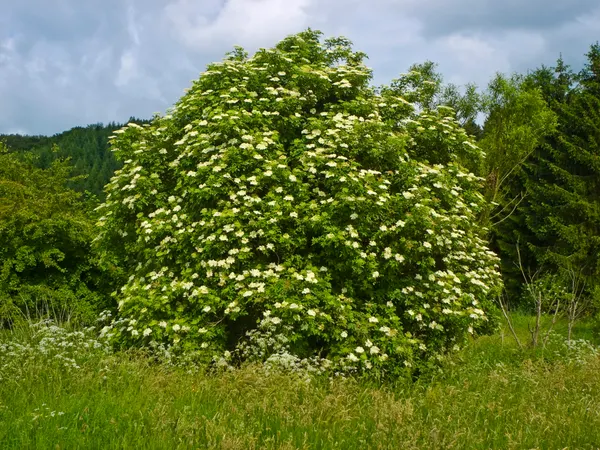
Elder / Elderflower
Sambucus nigra
Other names: Elder / Elderflower, Elder (Elderberry), Elder, Black Elder, ანწლი (relatives), Elder (elderflower & elderberry)
Edible plantPhoto credit: Willow
This plant carries serious safety risks. All information is for educational reference only.
Safety information
Toxicity: Flower: no side effects at assessment. RAW or unripe berries, and leaves/bark/stems, contain cyanogenic glycosides (sambunigrin) and can cause nausea, vomiting and diarrhea - berries must be COOKED before consumption. | Mild-to-serious by part/preparation. Bark and root are strong purgatives/emetics; leaves contain cyanogenic glucoside sambunigrin (yields hydrocyanic acid). Modern: raw/unripe berries, leaves, bark, stems cause nausea/vomiting/diarrhoea - cooking destroys this. | Mild — unripe/raw berries and the rest of the plant are toxic (must be cooked). | Leaf contains cyanogenetic glycoside (sambunigrin) — leaf is for external use; raw/unripe berries and green parts can cause GI upset. | Flowers and cooked ripe S. nigra berries are safe. Raw berries, leaves, bark, root and stems contain cyanogenic glycosides (sambunigrin) and lectins → nausea, vomiting, diarrhoea; cooking destroys/reduces these. Dwarf elder (Sambucus ebulus) is toxic and not a food. | Raw berries, seeds, leaves, bark and stems contain cyanogenic glycosides (sambunigrin) and lectins — raw/unripe berries cause nausea, vomiting, diarrhoea; cooking ripe berries destroys the toxin. Flowers are low-toxicity.
Contraindications: EMA flower use: adults/adolescents >12 only. | None explicitly specified (avoid raw/green parts is the practical rule). | Do not eat unripe berries; cook berries before use. | None specifically reported for properly prepared flower/cooked berry. | Avoid raw berries and all green parts entirely; medicinal use in pregnancy not established. Autoimmune disease — theoretical caution with immune-stimulating extracts. Diabetics: monitor (mild hypoglycaemic signals). | Do not eat raw berries/green parts; pregnancy caution for medicinal extracts.
Interactions: None stated on public summary; theoretical immune/diuretic effects (caution with diuretics/immunosuppressants - theoretical). | None specified by source. | None specifically noted. | None reported. | Theoretical additive with diuretics, diabetes drugs, and immune-modulating/immunosuppressant therapy (immunostimulant signals). | Theoretical immune/diuretic interactions; limited data.
Pregnancy & breastfeeding: Not specifically addressed; flower use restricted to >12. | Medicinal use not established. | Pregnancy caution for medicinal extracts.
Evidence level
Supported by clinical trials in humans.
Preparations
This plant carries serious safety risks. All information is for educational reference only.
infusion · flower
Part used: flower
Traditional use: Traditionally used (flower) for colds, influenza, hay fever and sinusitis; (berry) similarly plus rheumatism, with antiviral activity against influenza shown for standardised elderberry extract; (leaf, external) for bruises, sprains, wounds and chilblains.
How to prepare (traditional): Elderflower infusion: pour 1 cup of boiling water over 2 teaspoons of dried or fresh blossoms and infuse 10 minutes; drink hot. Elderberry juice: boil fresh berries in water 2-3 minutes then express the juice; preserve with 1 part honey to 10 parts juice brought to a boil. (An ointment of fresh leaf in petroleum jelly is made for external use.)
Dosage note (descriptive only): Flower infusion drunk hot three times a day; berry juice taken 1 glass diluted with hot water twice a day.
Reference only — not a dosage instruction
tincture · flower
Part used: flower
Traditional use: Traditionally for hay fever and allergies.
How to prepare (traditional): Tincture of the flowering tops taken with water.
Dosage note (descriptive only): For hay fever, take 1 tsp with water 3–4 times a day.
Reference only — not a dosage instruction
decoction · other
Part used: other
Traditional use: Traditionally for rheumatic aches; berries also have antiviral activity for colds and flu.
How to prepare (traditional): Decoction of the berries.
Dosage note (descriptive only): For rheumatic aches, take about 100 ml 3 times a day.
Reference only — not a dosage instruction
other · flower
Part used: flower
Traditional use: Traditionally applied to chapped skin.
How to prepare (traditional): Cream made with the flowering tops, applied freely.
Dosage note (descriptive only): Apply freely.
Reference only — not a dosage instruction
Associated conditions
Edibility
Edible parts: Flowers (cooked into cordials/fritters) and cooked, fully ripe berries. | cooked ripe berries (wine, jam, syrup, pies) and flowers (fritters, cordial); berries must be cooked | cooked ripe berries (syrups, jams) and flowers (cordial, fritters) | flowers and COOKED ripe berries (cordials, syrups, preserves). Do NOT eat raw/unripe berries, leaves, bark, or stems. | elderflowers (raw/cooked) and cooked ripe S. nigra berries only | Flowers; ripe berries cooked only.
Toxic lookalike warning
(1) Raw/unripe berries and all green parts are toxic - cook ripe berries only; (2) confused with dwarf elder (Sambucus ebulus), more toxic, and with poisonous white-umbel plants (water hemlock/hemlock, Cicuta/Conium) at a glance - positive ID essential. | Do not eat raw/unripe berries, leaves, stems or bark (cyanogenic). Dwarf Elder (Sambucus ebulus) is more toxic and can be confused with common elder. | Raw berries, leaves, bark and stems contain cyanogenic compounds — always cook berries; do not confuse with toxic dwarf elder (Sambucus ebulus) or other red-berried shrubs. | Do not confuse with dwarf elder (Sambucus ebulus), which is more toxic. | CRITICAL: distinguish edible Sambucus nigra (woody shrub/small tree, flat-topped creamy umbels, drooping ripe black berry clusters) from toxic dwarf elder Sambucus ebulus (herbaceous, upright/erect berry clusters, unpleasant smell) and from unrelated umbel/cluster plants; never eat raw, never eat green/unripe berries or any green parts. | CRITICAL: confused with dwarf elder / danewort (Sambucus ebulus), whose berries are more toxic and which is herbaceous (non-woody); far more dangerously, white elderflower umbels confused with flat white flower heads of deadly Apiaceae — poison hemlock (Conium), water hemlock (Cicuta) and hemlock water-dropwort (Oenanthe). Confirm elder is a woody shrub with pinnate opposite leaves and an arching umbel, not a hollow-stemmed herb.
Nutritional notes
Cooked berries: vitamin C, anthocyanins, fiber. | Traditional cordial/wine fruit; (modern) ripe cooked berries rich in anthocyanins and vitamin C. | Berries rich in vitamins A and C and anthocyanins. | Berries rich in anthocyanins/phenolics; functional antiviral food. | Elderberries: anthocyanins, vitamin C, vitamin B6; functional-food positioning. Elderflower: aromatic flavonoids. | Berries (cooked): anthocyanins, vitamin C; flowers: flavonoids. Functional-food role for anthocyanin/immune support.
Healing traditions
Related plants
Sources (8)
- Grieve M., A Modern Herbal (1931) — Maud Grieve (1931)
- Chevallier A., Encyclopedia of Herbal Medicine (2016) — Andrew Chevallier (2016)
- Hoffmann D., Medical Herbalism (2003) — David Hoffmann (2003)
- Bussmann et al., A comparative ethnobotany ... Republic of Georgia, J Ethnobiol Ethnomed 2016;12:43
- EMA/HMPC Sambuci flos monograph & public summary
- EMA/HMPC Sambuci flos (elder flower)
- Piršelová 2025 cyanogenic-glycoside review (PMC12350405)
- cooking-requirement public-health guidance