
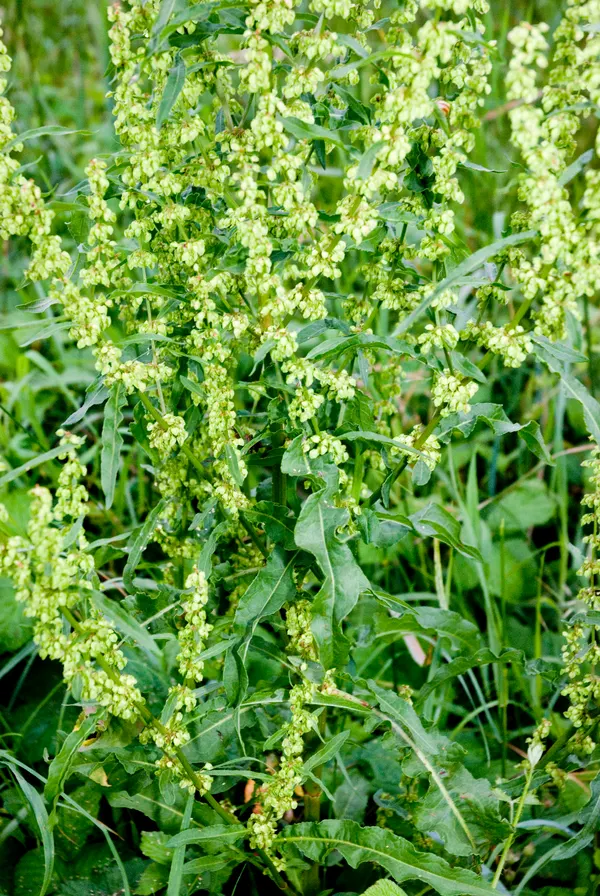
Yellow Dock
Rumex crispus
Other names: Yellow Dock, Curled / Broad-leaved dock
Edible plantPhoto credit: Olivier Pichard
Safety information
Safety information
Toxicity: Mild-moderate. Modern: docks/sorrels high in oxalic acid/oxalates - large leaf quantities can irritate kidneys; anthraquinone roots can over-purge. | Leaves contain high soluble oxalic acid — only young leaves, cooked, in moderation; large quantities risk oxalate toxicity (kidney). Root anthraquinones = laxative effect.
Contraindications: None specified by source. Modern: avoid large leaf quantities in oxalate-sensitive individuals; pregnancy caution for anthraquinone laxatives. | Calcium-oxalate kidney-stone history, renal impairment; pregnancy (anthraquinone root).
Interactions: None specified by source. | Root: theoretical additive effect with stimulant laxatives; oxalate may bind minerals.
Pregnancy & breastfeeding: Caution for anthraquinone laxatives (modern). | Pregnancy (anthraquinone root).
Evidence level
Documented in systematic traditional medicine literature.
Preparations
decoction · root
Part used: root
Traditional use: Traditionally used for chronic skin complaints such as psoriasis, as a gentle laxative for constipation, and as a liver/'blood-cleansing' alterative for jaundice from congestion.
How to prepare (traditional): Decoction: put 1-2 teaspoons of root in 1 cup of water, bring to a boil and simmer gently 10-15 minutes.
Dosage note (descriptive only): Drunk three times a day.
tincture · root
Part used: root
Traditional use: Alterative / mild laxative.
How to prepare (traditional): Tincture at 1:5 in 40% alcohol.
Dosage note (descriptive only): 1-2 ml three times a day.
Associated conditions
Edibility
Edible parts: young leaves/shoots as a (slightly laxative) cooked pot-herb | Leaf — young, cooked, in moderation.
Toxic lookalike warning
Young/basal dock leaves can be confused with Foxglove (Digitalis, deadly); foxglove leaves are softly downy and lack dock's papery sheath (ochrea) at the leaf base. | Dock leaves confused with young foxglove (Digitalis) rosettes (lethal cardiac glycosides) and with arum (Arum maculatum) — confirm dock's smooth, hairless lance-shaped leaves with a papery ochrea (sheath) at the stem node. Do not confuse with lords-and-ladies.
Nutritional notes
Leaves a traditional cooked green but high in oxalates; root carries tannin/anthraquinones. | Vitamin A, vitamin C, iron; high oxalate is the limiting factor. Root: iron and anthraquinones.
Healing traditions
Related plants
Sources (3)
- Grieve M., A Modern Herbal (1931) — Maud Grieve (1931)
- USDA/food-composition data
- ethnobotanical/foraging references for Rumex crispus
Sourcing & resources
Affiliate links — we may earn a small commission at no extra cost to you.