
Safety information
Safety information
Toxicity: Low — rose hips/petals are widely consumed. The seed 'hairs' inside hips are irritant (must be removed/strained).
Contraindications: None major at food doses; very high vitamin-C intake caution in those prone to oxalate stones (theoretical).
Interactions: None well documented (high vitamin C may marginally affect some assays/iron absorption).
Evidence level
Documented in systematic traditional medicine literature.
Preparations
decoction · flower/hip
Part used: flower/hip
powder · flower/hip
Part used: flower/hip
syrup/jam (hips) · hip
Part used: hip
Dosage note (descriptive only): deseeded/strained
infusion (tea) · flower/hip
Part used: flower/hip
Traditional use: wind-bile and blood-heat patterns; mild cooling/astringent, fragrant component; hips as vitamin-C-rich restorative, flowers in heat/liver formulas(Folk and historical sources have not been validated by clinical research.)
Proposed mechanism: hips rich in vitamin C, carotenoids, polyphenols (flavonoids, ellagitannins), organic acids; flowers contain flavonoids and aromatic compounds — antioxidant/astringent, mild anti-inflammatory
Associated conditions
Edibility
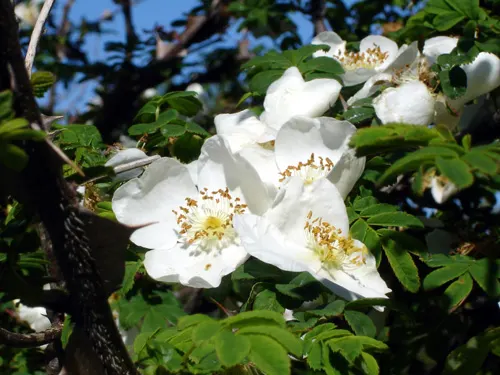
Edible parts: Rose hips eaten (deseeded/strained: jam, syrup, tea) and petals used in tea/food.
Toxic lookalike warning
Red rose hips can be confused with other red wild fruits/berries (some toxic, e.g. Daphne, certain Lonicera); the irritant internal hairs of hips must be removed; confirm thorny-rose identity before harvest.
Nutritional notes
Hips are an exceptional vitamin-C source plus carotenoids/polyphenols — strong functional-food profile.
Healing traditions
Related plants
- Tibetan anisodus / 'Tang-chu-tang'Anisodus tanguticusClinical
- SaffronCrocus sativusClinical
- Sea buckthornHippophae rhamnoidesClinical
- Amla (Indian gooseberry)Phyllanthus emblicaClinical
- Jatamansi (spikenard)Nardostachys jatamansiClinical
- Daruharidra (tree turmeric / Indian barberry)Berberis aristataClinical
Sources (2)
- Adhikari et al. 2019, Medicines (Basel) (PMID 31234605)
- Chaudhary et al. 2025, J Ethnobiol Ethnomed (PMID 41168804)
Sourcing & resources
Affiliate links — we may earn a small commission at no extra cost to you.