
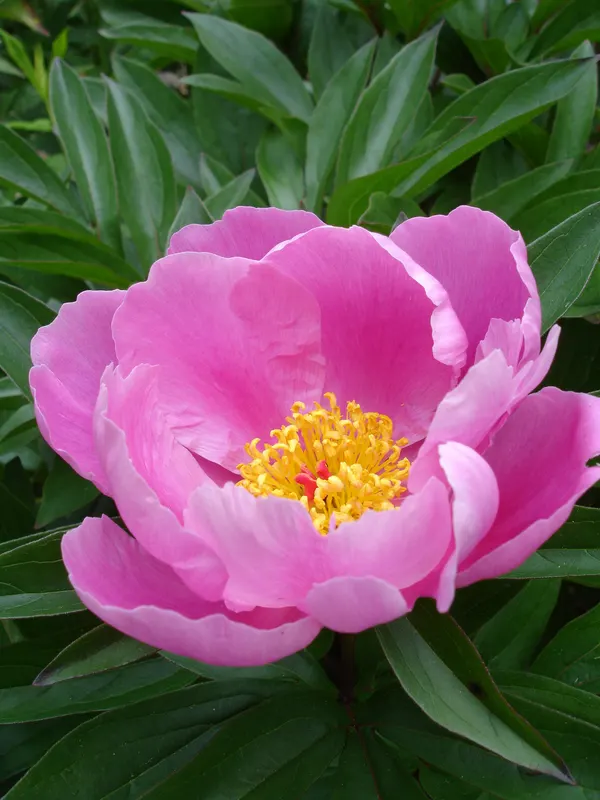
Chinese peony (white/red peony root)
Paeonia lactiflora
Other names: 芍药 / 芍藥 sháoyào; 白芍 báisháo; 赤芍 chìsháo, Chinese peony (white/red peony root)
Photo credit: Ulf Eliasson
Safety information
Safety information
Toxicity: Generally low-toxicity in traditional use; comprehensive human safety data limited.
Contraindications: Pregnancy/clinical data limited; traditional cautions in certain cold patterns.
Interactions: Not well characterized; theoretical interaction with anticoagulants.
Pregnancy & breastfeeding: Data limited.
Evidence level
Supported by laboratory or animal studies; not yet confirmed in humans.
Preparations
decoction · root
Part used: root
Traditional use: Traditionally to relieve period pain, heavy bleeding, and other menstrual disorders.
How to prepare (traditional): Decoction prepared from the boiled-and-dried root.
Dosage note (descriptive only): To relieve period pain, take about 75 ml 3 times a day.
other · root
Part used: root
Traditional use: The most widely used female tonic in China.
How to prepare (traditional): 'Four Things Soup' — white peony combined with rehmannia, chuan xiong, and dong quai.
Dosage note (descriptive only): Drink about 150 ml daily as a general tonic.
Associated conditions
Nutritional notes
Not a nutritional food; key constituent paeoniflorin (monoterpene glycoside).
Healing traditions
Related plants
Sources (2)
- Paeonia lactiflora (Wikipedia), English, accessed 2026, https://en.wikipedia.org/wiki/Paeonia_lactiflora
- Yan et al., Paeoniflorin, a novel heat shock protein-inducing compound, Cell Stress Chaperones 2004, PMC1065277
Sourcing & resources
Affiliate links — we may earn a small commission at no extra cost to you.