
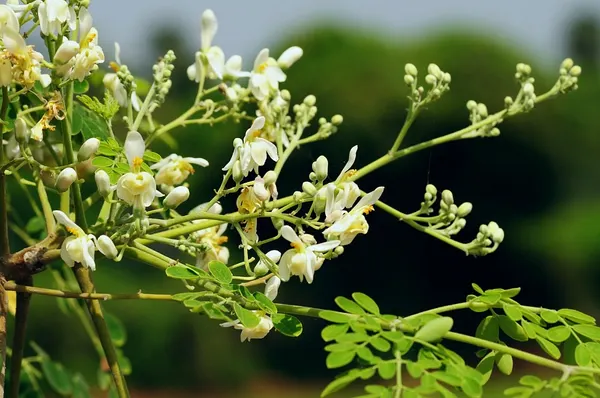
Moringa
Moringa oleifera
Other names: Moringa
Edible plantPhoto credit: Venkatx5
This plant carries serious safety risks. All information is for educational reference only.
Safety information
Toxicity: Leaves/pods food-safe; the ROOT and root bark contain alkaloids (spirochin) and are potentially toxic / traditionally abortifacient — FLAGGED, do not eat the root. Leaf at high supplement doses: limited safety data.
Contraindications: Pregnancy — avoid root/bark (abortifacient tradition) and high-dose leaf supplements (insufficient data).
Interactions: Theoretical additive glucose-lowering and effects on thyroid/levothyroxine at high intake; limited data.
Pregnancy & breastfeeding: Pregnancy — avoid root/bark (abortifacient tradition) and high-dose leaf supplements.
Evidence level
Reported in folk medicine sources; not clinically validated. Folk and historical sources have not been validated by clinical research.
Preparations
This plant carries serious safety risks. All information is for educational reference only.
cooked · pod
Part used: pod
Traditional use: vegetable (drumstick)(Folk and historical sources have not been validated by clinical research.)
cooked / dried-powdered · leaf
Part used: leaf
Traditional use: curries/soups; superfood powder
Proposed mechanism: glycaemic/lipid/antioxidant signals
Dosage note (descriptive only): high-dose leaf supplements: limited safety data
Reference only — not a dosage instruction
FLAGGED (do not eat) · root/bark
Part used: root/bark
Traditional use: alkaloids (spirochin), traditionally abortifacient(Folk and historical sources have not been validated by clinical research.)
Proposed mechanism: spirochin
Dosage note (descriptive only): FLAGGED — do not eat root
Reference only — not a dosage instruction
Associated conditions
Edibility
Edible parts: Leaves, pods, seeds, flowers (cooked); NOT root/bark (FLAGGED).
Toxic lookalike warning
Cultivated moringa grown as a known crop; the safety issue is the toxic root/bark of the same plant, not a separate lookalike — do not substitute root for the edible leaf.
Nutritional notes
Leaves exceptionally rich in vitamin A (beta-carotene), vitamin C, calcium, iron, potassium, protein and antioxidants — a key functional food for micronutrient-poor diets.
Healing traditions
Related plants
Sources (2)
- Sianipar 2026 Drug Des Devel Ther moringa human-studies review (PMC12912182)
- food-composition data for Moringa oleifera leaves