
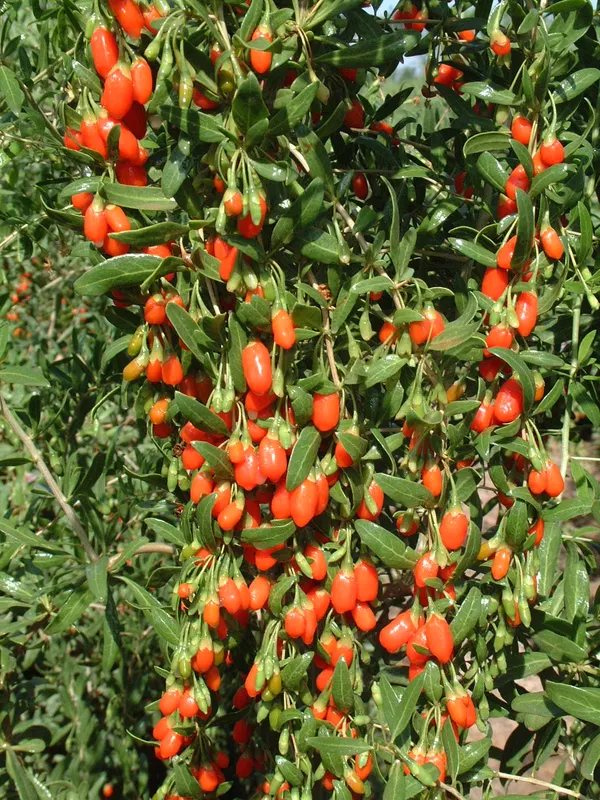
Goji / wolfberry
Lycium barbarum
Other names: 枸杞 gǒuqǐ; 宁夏枸杞 Níngxià gǒuqǐ, Goji / wolfberry
Edible plantPhoto credit: Paul Gross ( paul144 ) and Richard Zhang
Safety information
Safety information
Toxicity: Low for the fruit; atropine not detectable in fruit. Generally regarded as a safe food.
Contraindications: Caution with anticoagulants; pregnancy data limited.
Interactions: Case reports of interaction with warfarin (raised INR).
Pregnancy & breastfeeding: Data limited.
Evidence level
Supported by laboratory or animal studies; not yet confirmed in humans.
Preparations
edible dried · fruit
Part used: fruit
Traditional use: nourish liver/kidney yin, brighten the eyes
Proposed mechanism: polysaccharides, zeaxanthin
decoction/tea · fruit
Part used: fruit
Traditional use: tonic
tincture · fruit
Part used: fruit
Associated conditions
Edibility
Edible parts: Dried berries widely eaten raw, in teas, soups, and congee.
Toxic lookalike warning
Belongs to nightshade family (Solanaceae); do not confuse with other red Solanaceae berries; only L. barbarum / L. chinense wolfberries are the food/medicinal species.
Nutritional notes
Functional food. Fruit dry mass ~23% polysaccharides/proteoglycans; carotenoids (zeaxanthin dipalmitate); flavonoids (myricetin, quercetin, kaempferol derivatives); beta-sitosterol.
Healing traditions
Related plants
- BhumyamalakiPhyllanthus niruriClinical
- Daruharidra (tree turmeric / Indian barberry)Berberis aristataClinical
- Safflower / gur gum (hong hua, false saffron)Carthamus tinctoriusClinical
- Globe artichokeCynara scolymusClinical
- Kalmegh (King of Bitters)Andrographis paniculataClinical
- WormwoodArtemisia absinthiumClinical
Sources (2)
- Lycium barbarum (Wikipedia), English, accessed 2026, https://en.wikipedia.org/wiki/Lycium_barbarum
- Potterat O., Goji (Lycium barbarum and L. chinense): Phytochemistry, pharmacology and safety, Planta Medica 2010, doi:10.1055/s-0029-1186218
Sourcing & resources
Affiliate links — we may earn a small commission at no extra cost to you.