
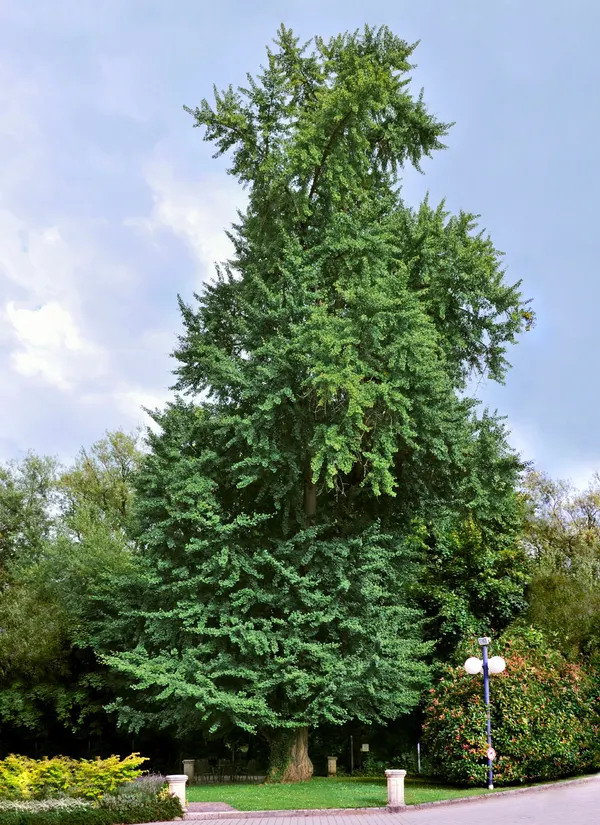
Ginkgo
Ginkgo biloba
Other names: Ginkgo
Edible plantPhoto credit: Cayambe / Ginkgotree (Wikimedia Commons)
This plant carries serious safety risks. All information is for educational reference only.
Safety information
Toxicity: Leaf extract generally well tolerated (dizziness, GI symptoms, headache). Fresh ginkgo SEEDS are toxic; roasted seeds/crude plant have caused serious poisoning (4'-O-methylpyridoxine / MPN - seizures), especially in children. | Use with care — toxic reactions if taken to excess; restricted in some countries. Raw/unprocessed seeds are toxic. | Raw ginkgo fruits are reportedly toxic (extracts are from leaves). Very low side-effect incidence for leaf extract.
Contraindications: Possibly unsafe in pregnancy (may trigger early labor/extra bleeding). Caution before surgery (bleeding); stop >=1-2 weeks pre-op. | Professional advice if on blood-thinning medication. | Caution with bleeding risk (antiplatelet effect).
Interactions: May increase bleeding risk with anticoagulants/antiplatelets (warfarin, aspirin); may interact with CNS and antiseizure drugs (may lower seizure threshold). | Anticoagulants/antiplatelets (bleeding risk). | Additive with other antiplatelet agents (bleeding reported with concentrated extract + long-term aspirin); may potentiate papaverine.
Pregnancy & breastfeeding: Possibly unsafe (may trigger early labor/extra bleeding). | Uterine-stimulant action listed — pregnancy caution.
Evidence level
Supported by clinical trials in humans.
Preparations
This plant carries serious safety risks. All information is for educational reference only.
other · leaf
Part used: leaf
Traditional use: Traditionally and clinically used for cerebral insufficiency in the elderly (memory, concentration, vertigo, tinnitus) and for peripheral arterial occlusive disease.
How to prepare (traditional): Modern use relies on a standardised leaf extract (50:1, standardised to about 22-27% ginkgo flavone glycosides and 5-7% terpene lactones), taken in divided doses; the crude leaf or simple extracts are not used in the studies.
Dosage note (descriptive only): 120-240 mg/day of standardised extract in divided doses; 4-8 weeks of daily use for optimal results.
Reference only — not a dosage instruction
tincture · leaf
Part used: leaf
Traditional use: Traditionally taken for poor circulation.
How to prepare (traditional): Tincture of the leaves taken with water.
Dosage note (descriptive only): professional use only — not provided
Reference only — not a dosage instruction
decoction · seed
Part used: seed
Traditional use: Traditionally used to treat wheezing.
How to prepare (traditional): Decoction of the seeds, used by herbalists.
Dosage note (descriptive only): professional use only — not provided
Reference only — not a dosage instruction
Associated conditions
Edibility
Edible parts: Leaf = no (extract only). Seeds historically eaten cooked in East Asia but are hazardous - see flag. | Seeds eaten (cooked) in East Asia in limited amounts; leaves not a food | roasted seed kernel eaten in East Asia (limited quantity); raw fruit toxic
Toxic lookalike warning
Ginkgo seed kernels are toxic raw and in quantity even when cooked.
Nutritional notes
Not used as a Western food. | Not a Western food. | Not relevant for leaf preparations.
Healing traditions
Related plants
Sources (3)
- Chevallier A., Encyclopedia of Herbal Medicine (2016) — Andrew Chevallier (2016)
- Hoffmann D., Medical Herbalism (2003) — David Hoffmann (2003)
- NCCIH Ginkgo fact sheet (DeKosky 2008 GEM trial, JAMA, PMID 19017911; Liao 2020, PMID 32658034; Liu 2022 J Ethnopharmacol, PMID 35988840)