
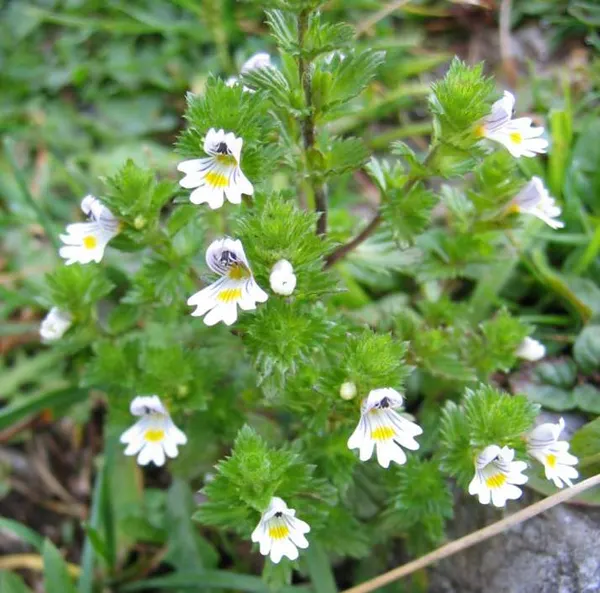
Eyebright
Euphrasia officinalis
Other names: Eyebright
Photo credit: Wikimedia Commons contributor
Safety information
Safety information
Toxicity: None known per source (low). Modern caution: applying non-sterile herbal infusions to the eye risks contamination/infection.
Contraindications: None specified by source.
Interactions: None specified by source.
Evidence level
Reported in folk medicine sources; not clinically validated. Folk and historical sources have not been validated by clinical research.
Preparations
infusion · aerial parts
Part used: aerial parts
Traditional use: Traditionally used internally as an anticatarrhal for nasal catarrh and sinusitis, and (with internal use) as an eye compress for conjunctivitis and blepharitis.
How to prepare (traditional): Infusion: pour 1 cup of boiling water over 1 teaspoon of dried herb and infuse 5-10 minutes. For an eye compress, place 1 teaspoon of dried herb in about 0.5 L of water, boil 10 minutes, cool slightly, moisten a cloth and place over the eyes for 15 minutes.
Dosage note (descriptive only): Infusion drunk three times a day; compress repeated several times a day.
tincture · aerial parts
Part used: aerial parts
Traditional use: Anticatarrhal.
How to prepare (traditional): Tincture at 1:5 in 45% alcohol.
Dosage note (descriptive only): 1-4 ml three times a day.
Associated conditions
Nutritional notes
Not relevant.
Healing traditions
Related plants
Sources (1)
- Grieve M., A Modern Herbal (1931) — Maud Grieve (1931)
Sourcing & resources
Affiliate links — we may earn a small commission at no extra cost to you.