
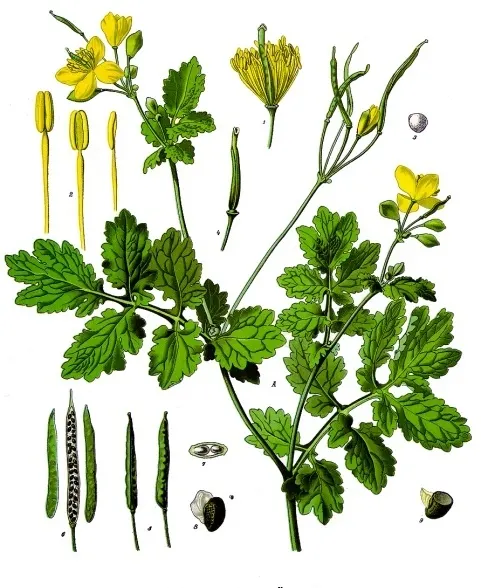
This plant carries serious safety risks. All information is for educational reference only.
Safety information
Toxicity: Chelidonium majus contains toxic isoquinoline alkaloids (chelidonine, sanguinarine). Internal use associated with idiosyncratic hepatotoxicity (acute hepatitis, documented case reports); the fresh latex is a caustic irritant. Not a safe self-treatment plant; dripping caustic latex into the eye risks corneal injury. | SERIOUS — HEPATOTOXIC. Whole plant contains toxic isoquinoline alkaloids. Oral use has caused elevated liver enzymes and toxic hepatitis, including a documented fatality; NIH LiverTox lists it as a cause of drug-induced liver injury. Sap is a mucous-membrane/eye irritant. Poisonous to poultry.
Contraindications: Liver disease; pregnancy/breastfeeding; any eye use. | Do NOT use internally. Avoid entirely in pregnancy/breastfeeding, in children, and in anyone with liver disease or on hepatotoxic drugs.
Interactions: Additive hepatotoxicity with liver-stressing drugs/herbs. (Safety gate.) | Additive liver injury with other hepatotoxic drugs/herbs; was a component of Iberogast, linked to hepatotoxicity warnings.
Pregnancy & breastfeeding: Contraindicated. | Avoid entirely.
Evidence level
Reported in folk medicine sources; not clinically validated. Folk and historical sources have not been validated by clinical research.
Preparations
This plant carries serious safety risks. All information is for educational reference only.
FLAGGED (no how-to) · aerial herb/root/latex
Part used: aerial herb/root/latex
Traditional use: cataract (latex in eye - do not), GI spasms/meteorism, bladder pain, heart complaints, liver/gallbladder(Folk and historical sources have not been validated by clinical research.)
Proposed mechanism: toxic isoquinoline alkaloids (chelidonine, sanguinarine)
Dosage note (descriptive only): no how-to reproduced
Reference only — not a dosage instruction
none provided (safety-flag entry)
Traditional use: historically: fresh latex dabbed on warts/skin growths; internal preparations folk-used for liver/gallbladder and digestive complaints(Folk and historical sources have not been validated by clinical research.)
Proposed mechanism: Toxic isoquinoline alkaloids (coptisine, chelidonine, sanguinarine, chelerythrine, berberine, protopine) — hepatotoxic
Dosage note (descriptive only): NOT PROVIDED — safety-flag entry, not a how-to
Reference only — not a dosage instruction
Associated conditions
Nutritional notes
None — toxic medicinal/poisonous plant, not a food.
Healing traditions
Related plants
Sources (4)
- ნუნუ ღლიღვაშვილი-მარგიანი, "მედეადან დღემდე" (Nunu Ghlighvashvili-margiani, "From Medea to the present day")
- Chelidonium majus — Wikipedia (cites EMA, Pantano 2017, LiverTox), 2025
- Greater Celandine — LiverTox / NIDDK (NBK548684, PMID 31643995)
- Final assessment report on Chelidonium majus L., herba — EMA/HMPC, 2011