
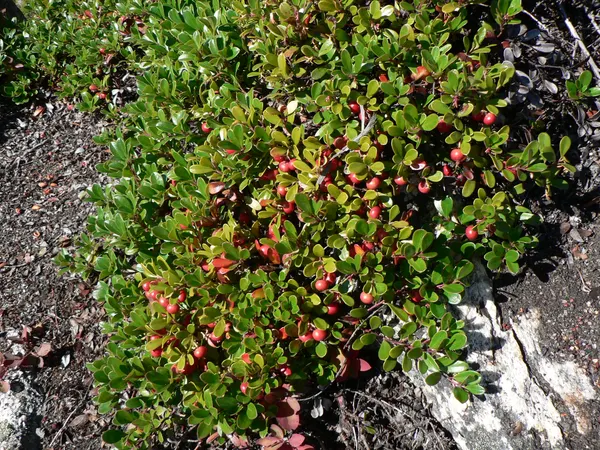
Bearberry
Arctostaphylos uva-ursi
Other names: Bearberry
Photo credit: Walter Siegmund
Safety information
Safety information
Toxicity: Hydroquinone-yielding — not for prolonged/high-dose use.
Contraindications: None specifically detailed beyond the interaction.
Interactions: Urinary acidifiers inhibit conversion of arbutin to active hydroquinone, reducing effectiveness.
Evidence level
Documented in systematic traditional medicine literature.
Preparations
infusion · leaf
Part used: leaf
Traditional use: Traditionally used as a urinary antiseptic and astringent for cystitis, pyelitis and conditions with gravel or ulceration in kidney/bladder; also as a douche.
How to prepare (traditional): Infusion: pour 1 cup of boiling water over 1-2 teaspoons of dried leaves and infuse, covered, 10-15 minutes. Commission E also describes a cold macerate.
Dosage note (descriptive only): Drunk three times a day. Commission E: 10-12 g (about 400-840 mg arbutin) in 150 ml water.
tincture · leaf
Part used: leaf
Traditional use: Urinary antiseptic.
How to prepare (traditional): Tincture at 1:5 in 25% alcohol.
Dosage note (descriptive only): 2-4 ml three times a day.
Associated conditions
Healing traditions
Related plants
Sources (1)
- Hoffmann D., Medical Herbalism (2003) — David Hoffmann (2003)
Sourcing & resources
Affiliate links — we may earn a small commission at no extra cost to you.