
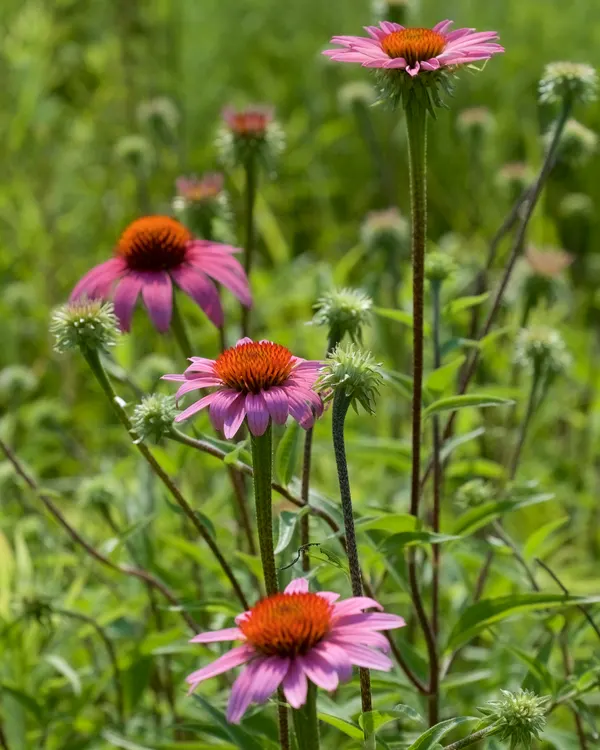
Echinacea (Purple coneflower)
Echinacea purpurea(?)
Other names: Echinacea (Purple coneflower), Echinacea
Photo credit: Eric Hunt
Safety information
Safety information
Toxicity: Generally mild (GI upset). Serious allergic reactions reported especially in atopic individuals (rash; rare Stevens-Johnson syndrome, asthma, anaphylaxis - frequency unknown). | Mild — rare allergic reactions (Asteraceae). | None known reported.
Contraindications: Hypersensitivity to Asteraceae (Compositae). EMA restricts oral cold use to adults/adolescents >12. Caution in children (allergy risk). Progressive systemic/autoimmune disease historically cautioned. | Asteraceae allergy caution. | None specifically named (general caution with autoimmune conditions implied by class).
Interactions: Conflicting evidence on interaction with drugs metabolized by the liver (CYP3A4/CYP1A2 variably); theoretical concern with immunosuppressants; possible reduced caffeine clearance. | None specifically noted. | None specifically reported.
Pregnancy & breastfeeding: Not specifically addressed; oral cold use restricted to adults/adolescents >12.
Evidence level
Supported by clinical trials in humans.
Preparations
decoction (gargle) · root
Part used: root
Traditional use: throat infections
expressed juice · fresh/dried herb
Part used: fresh/dried herb
Traditional use: short-term prevention/treatment of common cold
Proposed mechanism: alkylamides, cichoric acid and polysaccharides proposed immunomodulators (macrophage/cytokine, NF-kB) - preclinical
Dosage note (descriptive only): EMA well-established-use expressed-juice products taken short-term, used at first signs of a cold up to ~10 days; strengths vary. Descriptive only.
topical ointment / tincture / infusion · herb/root
Part used: herb/root
Traditional use: minor superficial wounds
Proposed mechanism: immunomodulatory constituents - preclinical
Dosage note (descriptive only): descriptive only
tincture · root
Part used: root
Traditional use: immune stimulant for colds, flu, upper-respiratory infections; boils, acne, other infections
Proposed mechanism: raises white-blood-cell number/activity; polysaccharides hinder viral cell entry; alkylamides antibacterial/antifungal
capsules/tablets · root
Part used: root
Traditional use: immune support
tincture · root
Part used: root
Traditional use: antimicrobial/immunomodulator for bacterial/viral infections, boils, septicemia, upper respiratory infection (laryngitis, tonsillitis, colds, catarrh); cystitis
Proposed mechanism: echinacoside mild antibacterial; immune-stimulating
mouthwash · root
Part used: root
Traditional use: gingivitis/pyorrhea
external lotion · root
Part used: root
Traditional use: septic sores
Associated conditions
Nutritional notes
Not relevant as a food. | Not a food.
Healing traditions
Related plants
Sources (4)
- Chevallier A., Encyclopedia of Herbal Medicine (2016) — Andrew Chevallier (2016)
- Hoffmann D., Medical Herbalism (2003) — David Hoffmann (2003)
- EMA/HMPC Echinaceae purpureae herba monograph & public summary
- NCCIH Echinacea fact sheet (David & Cunningham 2019 meta-analysis, PMID 31126553; Anheyer 2018, PMID 28610802)
Sourcing & resources
Affiliate links — we may earn a small commission at no extra cost to you.