
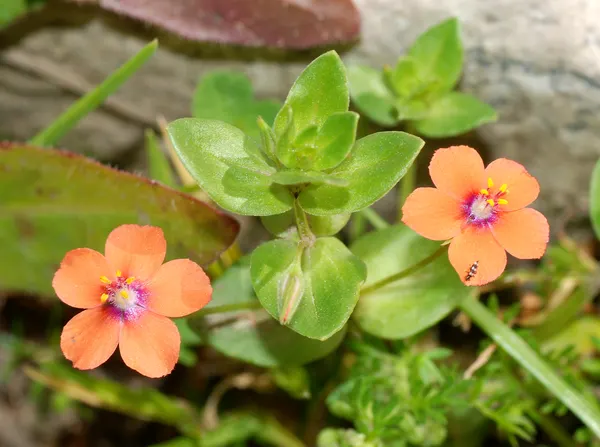
Scarlet pimpernel
Anagallis arvensis
Other names: Poor man's weatherglass, red chickweed, shepherd's clock, Lysimachia arvensis (syn.)
Photo credit: Alvesgaspar / Wikimedia Commons
This plant carries serious safety risks. All information is for educational reference only.
Safety information
Toxicity: SERIOUS for internal use — all parts contain saponins (e.g. cyclamin, concentrated in root), cucurbitacins and tannins. Ingestion can cause mucous-membrane irritation, vomiting, diarrhoea, tremor; high doses → cramps, respiratory paralysis; nephrotoxic at higher doses in livestock and humans. Contact dermatitis on skin handling.
Contraindications: Internal use not recommended; pregnancy/lactation; children; renal impairment.
Interactions: Not well characterized; theoretical additive irritant/nephrotoxic and saponin-related GI effects — avoid combining with other internal medicines.
Pregnancy & breastfeeding: Contraindicated in pregnancy/lactation.
Evidence level
Reported in folk medicine sources; not clinically validated. Folk and historical sources have not been validated by clinical research.
Preparations
This plant carries serious safety risks. All information is for educational reference only.
infusion · whole herb
Part used: whole herb
Traditional use: historical folk remedy (context only — not recommended)(Folk and historical sources have not been validated by clinical research.)
Dosage note (descriptive only): no internal-use how-to; not recommended
Reference only — not a dosage instruction
Associated conditions
Healing traditions
Related plants
Sources (3)
- Anagallis arvensis — Useful Temperate Plants (EN)
- Pharmacological properties of Anagallis arvensis L. … wound-healing remedies in Navarra (Spain) (J. Ethnopharmacology)
- Scarlet Pimpernel — WebMD (EN)