
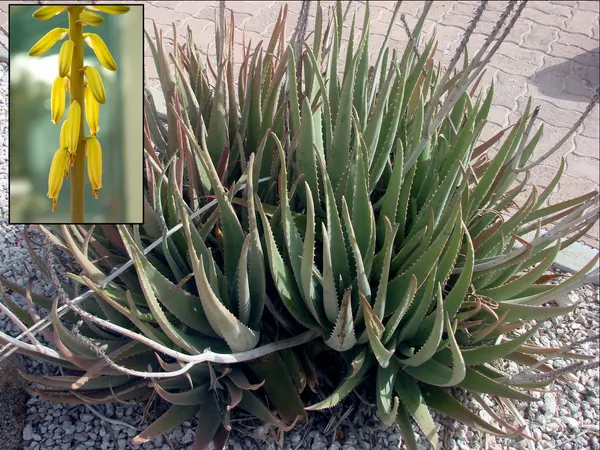
This plant carries serious safety risks. All information is for educational reference only.
Safety information
Toxicity: Topical gel: occasional irritation/allergy. Oral whole-leaf/latex: cramping, diarrhea, electrolyte loss; non-decolorized whole-leaf extract classified by IARC as possibly carcinogenic to humans (Group 2B) and caused intestinal tumors in rodent studies. Rare hepatotoxicity reports with oral aloe (LiverTox). | Mild (gel) to serious (bitter aloes — purgative). Bitter sap use restricted in some countries.
Contraindications: Oral latex/whole-leaf: contraindicated in pregnancy, breastfeeding, children, and in intestinal obstruction/IBD/appendicitis (as with all stimulant laxatives). Topical: avoid on deep/serious wounds without care. | Do not take bitter aloes internally in pregnancy/breastfeeding, or with haemorrhoids or kidney disease. Do not apply bitter yellow sap to skin.
Interactions: Oral latex laxative: potassium loss potentiates cardiac glycosides (digoxin), and interacts with diuretics, corticosteroids, antiarrhythmics (as with senna). Oral gel: theoretical additive hypoglycemia with antidiabetics. | None specifically noted (laxative anthraquinones — usual caution).
Pregnancy & breastfeeding: Oral latex/whole-leaf contraindicated in pregnancy and breastfeeding. | Do not take bitter aloes internally in pregnancy/breastfeeding (abortifacient risk).
Evidence level
Supported by laboratory or animal studies; not yet confirmed in humans.
Preparations
This plant carries serious safety risks. All information is for educational reference only.
other · leaf
Part used: leaf
Traditional use: First-aid remedy for burns, scrapes, scalds, sunburn, and skin conditions needing soothing.
How to prepare (traditional): Break off a leaf and split it open to collect the clear gel.
Dosage note (descriptive only): For burns and eczema, apply liberally twice a day.
Reference only — not a dosage instruction
tincture · leaf
Part used: leaf
Traditional use: Low-dose bitter to stimulate digestion/appetite (bitter aloes; anthraquinone-containing, strongly laxative at higher doses).
How to prepare (traditional): Tincture made from the bitter yellow juice (bitter aloes) from the base of the leaves.
Dosage note (descriptive only): To stimulate the appetite, take 3 drops with water before meals.
Reference only — not a dosage instruction
Associated conditions
Edibility
Edible parts: Decolorized inner-leaf gel used in some foods/drinks. The green rind and yellow latex are NOT food (anthraquinone/genotoxicity concern). Whole raw leaf should not be eaten without proper preparation. | Gel can be taken internally (commercial juice); leaf not eaten raw (irritant sap)
Nutritional notes
Inner gel mostly water; minor. | Polysaccharide gel; no notable nutrition.
Healing traditions
Related plants
Sources (4)
- Chevallier A., Encyclopedia of Herbal Medicine (2016) — Andrew Chevallier (2016)
- NCCIH Aloe Vera fact sheet
- NIH LiverTox Aloe Vera chapter
- EMA/HMPC Aloe (Barbados/Cape) and HMPC hydroxyanthracene-derivative public statement