
Garlic
Allium sativum
Other names: Garlic, ნიორი, ნიორი (niori)
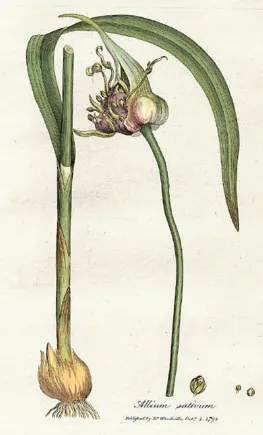
Edible plantPhoto credit: Woodville, Medical Botany (1793)
Safety information
Safety information
Toxicity: Breath/body odor, GI upset, flatulence, nausea; allergy. Raw garlic applied to skin can cause chemical burns/severe irritation (Hitl 2021, PMID 33571752). | Low as food. Modern: raw garlic can cause GI upset, heartburn, and skin/mucosal burns on prolonged contact. | None known at culinary doses (book calls it completely safe for home use). | High doses may irritate intestinal mucosa (nausea, diarrhea, vomiting, mouth burning). Occupational contact dermatitis reported. | Low as food; raw excess irritates GI tract and can burn skin (topical). | Mild — breath/body odour, GI upset, heartburn. Topical raw garlic causes chemical burns (case-series documented). | Low; raw garlic on skin can cause irritation/contact burns with prolonged application (general knowledge).
Contraindications: Increased bleeding risk - caution before surgery. Oral amounts above culinary levels possibly unsafe in pregnancy/breastfeeding. | None specified by source. Modern: stop before surgery (bleeding risk). | Consult a practitioner before giving medicinally to children under 12. | Caution before/after surgery. | Book notes: duodenal ulcer, high-acid gastritis, pancreatitis, nephritis, pregnancy, epilepsy (for raw garlic; cooked garlic said to be without contraindication); plus bleeding disorders/pre-surgery. | Caution before surgery and with bleeding disorders (antiplatelet effect); GERD. | (General knowledge) bleeding disorders / pre-surgery (antiplatelet effect) for high internal doses; topical caution on broken skin.
Interactions: May increase bleeding with anticoagulants/antiplatelets and aspirin; may reduce levels of some drugs (saquinavir and possibly other CYP3A4 substrates) - consult provider. | None specified by source. Modern: potentiates anticoagulants/antiplatelets (bleeding); may reduce levels of some drugs (certain HIV protease inhibitors). | Caution with blood-thinning medication (additive effect). | Therapeutic doses may potentiate anticoagulants and antithrombotic action of anti-inflammatories such as aspirin. | Organosulfur compounds add to anticoagulants/antiplatelets (warfarin, aspirin), antihypertensives, antidiabetics, and can reduce levels of some antiretrovirals - clinically relevant at high intake. (Safety gate.) | May reduce levels of some drugs (e.g. saquinavir); additive with anticoagulants/antiplatelets; possible effect on certain HIV drugs. | (General knowledge) potentiates anticoagulants/antiplatelets; may affect some antiretrovirals.
Pregnancy & breastfeeding: Oral amounts above culinary levels possibly unsafe in pregnancy/breastfeeding. | Book contraindicates raw garlic in pregnancy.
Evidence level
Supported by clinical trials in humans.
Preparations
other · bulb
Part used: bulb
Traditional use: To help reduce cholesterol levels and boost the immune system.
How to prepare (traditional): Fresh cloves chopped or crushed; book notes it is best to crush cloves and wait 10 minutes before use to allow allicin to form. Used regularly in cooking.
Dosage note (descriptive only): Use regularly in cooking.
syrup · bulb
Part used: bulb
Traditional use: For coughs.
How to prepare (traditional): Garlic syrup.
Dosage note (descriptive only): For coughs, take 1 tsp every 3 hours.
capsule · bulb
Part used: bulb
Traditional use: For bronchitis, chest infections, high blood pressure, and to increase resistance to infection.
How to prepare (traditional): Capsules; also 'pearls' containing garlic oil and tablets.
Dosage note (descriptive only): For bronchitis, take 2 x 100 mg capsules 3 times a day. Pearls taken to increase resistance to infection; tablets for high blood pressure and bronchitis.
Associated conditions
Edibility
Edible parts: bulb/cloves, raw or cooked, a primary culinary food | bulb/cloves raw or cooked | cloves, raw or cooked; a staple food/spice | bulb, raw or cooked | Culinary staple. | Bulb/clove raw or cooked. | Bulb, raw or cooked (common food).
Toxic lookalike warning
Wild Allium foraging generally safe by smell, BUT plants lacking the onion/garlic odor that resemble Allium leaves - lily-of-the-valley (Convallaria majalis), Colchicum autumnale (autumn crocus), death camas (Toxicoscordion/Zigadenus) - are highly toxic and have caused fatal poisonings. Never eat a bulb/leaf that does not smell of garlic/onion. | Wild garlic/ramsons (A. ursinum) leaves resemble poisonous Lily-of-the-Valley, Lords-and-Ladies (Arum), and Autumn Crocus (Colchicum, potentially fatal) - the garlic smell when crushed is the key check. | Wild Allium foragers must avoid lily-family lookalikes lacking the onion smell (e.g. Colchicum). | Wild Allium gathering only (see ramsons concerns); cultivated garlic itself is unambiguous. | Cultivated garlic unmistakable, but wild Allium foragers must not confuse bulbs/leaves with Colchicum autumnale, Convallaria majalis or other toxic bulbs (see wild-garlic entry) — the garlic smell is the discriminator.
Nutritional notes
Functional food; organosulfur compounds (allicin), manganese, vitamin B6, vitamin C; low calorie. | Pungent culinary bulb; aids digestion. | Functional food; selenium and vitamins A, B, C, E; cardiovascular and immune support. | B vitamins, minerals, flavonoids; functional food with cardiovascular/antimicrobial roles. | Organosulfur compounds (allicin), manganese, vitamin B6, vitamin C, selenium. | Organosulfur compounds (allicin from alliin on crushing), manganese, vitamin B6, vitamin C, selenium; functional cardiovascular food. | Organosulfur compounds, vitamin C, manganese (general).
Healing traditions
Related plants
Sources (6)
- Grieve M., A Modern Herbal (1931) — Maud Grieve (1931)
- Chevallier A., Encyclopedia of Herbal Medicine (2016) — Andrew Chevallier (2016)
- Hoffmann D., Medical Herbalism (2003) — David Hoffmann (2003)
- ნუნუ ღლიღვაშვილი-მარგიანი, "მედეადან დღემდე" (Nunu Ghlighvashvili-margiani, "From Medea to the present day")
- NCCIH Garlic fact sheet (Ried 2013 Nutr Rev, PMID 23590705; Sun 2018, PMID 29718835; Shabani 2019, PMID 30049636; Hitl 2021, PMID 33571752)
- Masalebi Saqartvelos Etnografiisatvis, 2020, N1 (2020)
Sourcing & resources
Affiliate links — we may earn a small commission at no extra cost to you.