
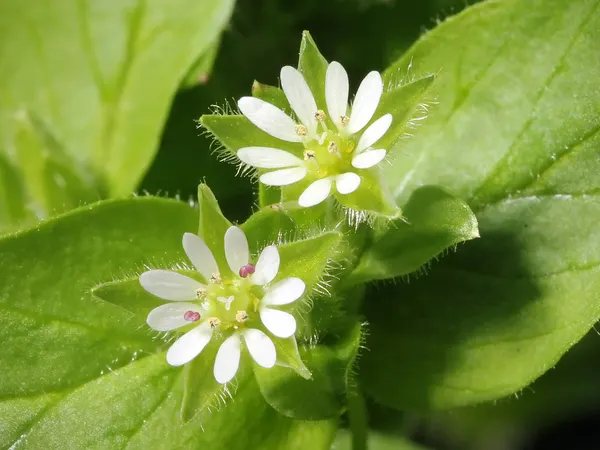
Chickweed
Stellaria media
Other names: Chickweed
Edible plantPhoto credit: Kaldari
Safety information
Safety information
Toxicity: Generally regarded as low toxicity as a food green. Saponins mean very large quantities could cause GI upset; chickweed can accumulate nitrates/oxalates and (like any wild green) may take up soil contaminants - eat in moderation. | None known; a common, benign edible weed. | Low; contains saponins and some nitrate/oxalate — large raw quantities can cause GI upset.
Contraindications: Hypersensitivity. Pregnancy/breastfeeding: insufficient data for medicinal use; culinary amounts of a common salad green a different matter. Eat in moderation. | None specified by source. | None well established; moderation due to saponins.
Interactions: None documented; theoretical only. | None specified by source. | None established.
Pregnancy & breastfeeding: Insufficient data for medicinal use.
Evidence level
Reported in folk medicine sources; not clinically validated. Folk and historical sources have not been validated by clinical research.
Preparations
ointment, poultice, decoction, infusion, expressed juice, edible salad/pot-herb · whole herb
Part used: whole herb
Traditional use: cooling ointment/poultice for inflammation, indolent ulcers, abscesses, carbuncles, piles, sores, skin diseases; infusion for coughs/hoarseness; juice for scurvy; chickweed water for obesity(Folk and historical sources have not been validated by clinical research.)
Proposed mechanism: demulcent and refrigerant (Grieve)
edible-raw · aerial parts
Part used: aerial parts
Traditional use: salad(Folk and historical sources have not been validated by clinical research.)
lightly cooked · aerial parts
Part used: aerial parts
Traditional use: potherb(Folk and historical sources have not been validated by clinical research.)
poultice · aerial parts
Part used: aerial parts
Traditional use: topical for itching/skin (folk)(Folk and historical sources have not been validated by clinical research.)
topical poultice/ointment/infused oil / infusion / young aerial parts edible raw or cooked · aerial parts
Part used: aerial parts
Traditional use: folk topical use for itching, minor skin irritation, eczema and minor wounds (cooling/soothing herb); minor internal folk use as a mild spring tonic green(Folk and historical sources have not been validated by clinical research.)
Proposed mechanism: saponins, mucilage and flavonoids proposed soothing/anti-itch constituents - minimal/preclinical data; mechanism largely unestablished
Dosage note (descriptive only): folk topical application (poultice/ointment) and culinary use; no standardized therapeutic regimen; descriptive only
Associated conditions
Edibility
Edible parts: tender aerial parts raw (salads) or lightly cooked, a common wild green | young leaves/tops cooked or raw in salad | Raw or cooked.
Toxic lookalike warning
Confused with toxic lookalikes, notably scarlet pimpernel (Anagallis arvensis/Lysimachia arvensis) and spurges (Euphorbia spp., which have irritant milky latex); true chickweed has a single line of hairs running along one side of the stem and no milky sap - positively identify before eating. | Distinguish from Scarlet Pimpernel (Anagallis arvensis, mildly toxic) and spurges (Euphorbia, acrid/toxic, milky sap); true chickweed has a single line of hairs running up one side of the stem. | Confused with scarlet pimpernel (Anagallis/Lysimachia arvensis) and spurge (Euphorbia spp.), both toxic. Key check: true chickweed has a single line of fine hairs running along one side of the stem (switching sides at each node) and a stretchy inner core; spurge bleeds milky latex (reject); pimpernel has square stems and orange/red flowers.
Nutritional notes
Wild green - vitamin C, some minerals; low calorie. Minor food role. | Mild green; traditional spring salad/pot-herb and bird food. | Vitamin C, vitamin A, some minerals; low calorie salad green.
Healing traditions
Related plants
Sources (5)
- Grieve M., A Modern Herbal (1931) — Maud Grieve (1931)
- no EMA/NCCIH monograph (folk status noted honestly)
- Standard Western foraging/ethnobotany references (regional wild-food and herbal field guides)
- Foraging/food-composition references for Stellaria media
- general botanical floras
Sourcing & resources
Affiliate links — we may earn a small commission at no extra cost to you.