
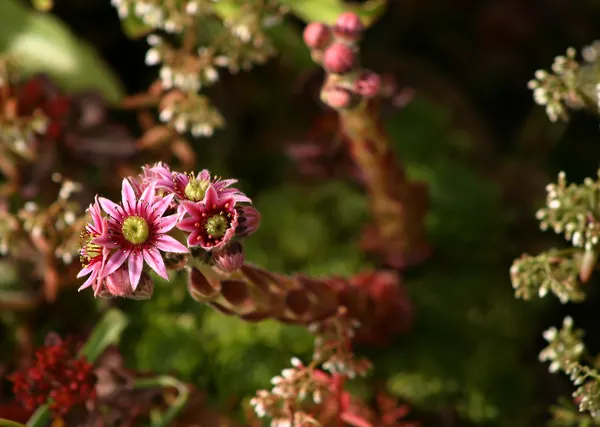
Houseleek
Sempervivum tectorum
Other names: Common houseleek, hen-and-chicks, Jupiter's beard, Hauswurz
Photo credit: Wikimedia Commons
Safety information
Safety information
Toxicity: Low for external use; tannin/flavonoid astringent. Internal use not established/recommended.
Contraindications: Deep or serious wounds/burns, eye, and ear-canal use — avoid unless a clinician confirms; known hypersensitivity.
Interactions: None documented for topical use.
Evidence level
Reported in folk medicine sources; not clinically validated. Folk and historical sources have not been validated by clinical research.
Preparations
poultice · leaf
Part used: leaf
Traditional use: cooling/soothing for minor burns, insect bites, warts, corns, minor skin inflammation(Folk and historical sources have not been validated by clinical research.)
Proposed mechanism: tannin/flavonoid astringent; phenolic antinociceptive (preclinical)
Dosage note (descriptive only): topical only; not for serious burns/eyes/ear
Associated conditions
Nutritional notes
Not a food source (succulent water + polyphenols/polysaccharides)
Healing traditions
Related plants
Sources (3)
- Grieve M., A Modern Herbal (1931) — Maud Grieve (1931)
- Characterization of phenolic compounds and antinociceptive activity of Sempervivum tectorum L. leaf juice
- Houseleek (Sempervivum tectorum) for Skin Care, Traditional Uses, and Safety — VitaLibrary (EN)
Sourcing & resources
Affiliate links — we may earn a small commission at no extra cost to you.