
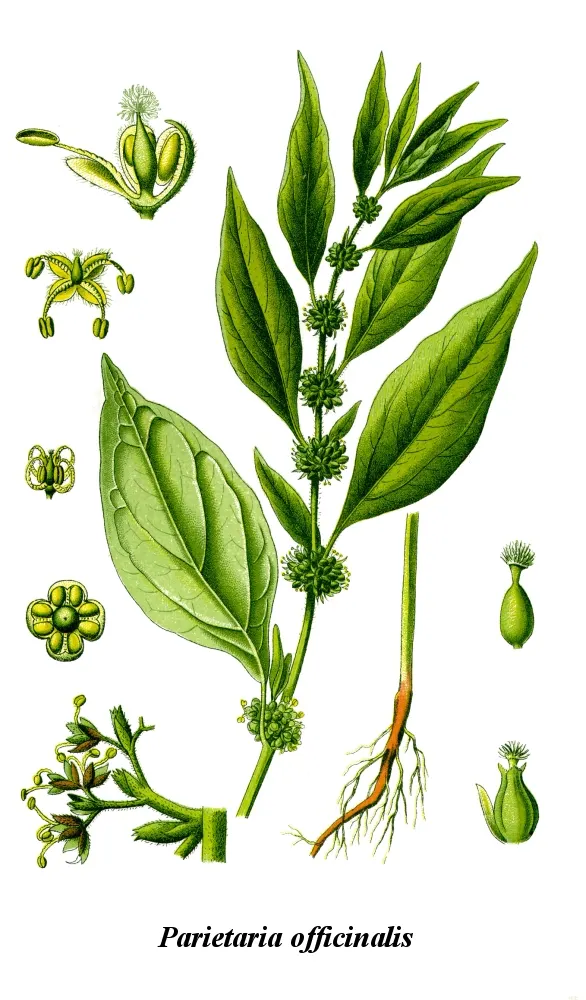
Pellitory-of-the-wall
Parietaria officinalis
Other names: Lichwort, wall pellitory
Photo credit: Chrizz / Wikimedia Commons
Safety information
Safety information
Toxicity: Low for the herb internally at traditional doses; data limited. The major hazard is the POLLEN, a leading cause of respiratory allergy/hay fever in Mediterranean cities (not the tea itself).
Contraindications: Known Urticaceae/pellitory pollen allergy or asthma — avoid (handling/airborne exposure can trigger reactions); pregnancy/lactation (insufficient data); conditions requiring fluid restriction.
Interactions: Theoretical additive effect with diuretics and with potassium-affecting drugs (herb is potassium-nitrate-rich) — caution with potassium-sparing diuretics/ACE inhibitors and in renal impairment.
Pregnancy & breastfeeding: Avoid (insufficient data).
Evidence level
Reported in folk medicine sources; not clinically validated. Folk and historical sources have not been validated by clinical research.
Preparations
infusion · aerial parts
Part used: aerial parts
Traditional use: demulcent diuretic; support urine flow and passage of small renal calculi; chronic dry cough(Folk and historical sources have not been validated by clinical research.)
Proposed mechanism: high potassium-nitrate content
Associated conditions
Nutritional notes
Not a food source
Healing traditions
Related plants
Sources (3)
- Parietaria officinalis — Wikipedia (EN)
- Parietaria officinalis, Pellitory of the wall — Botanical-online (EN)
- Pellitory of the wall (Parietaria officinalis) — Herbal Reality (EN)
Sourcing & resources
Affiliate links — we may earn a small commission at no extra cost to you.