
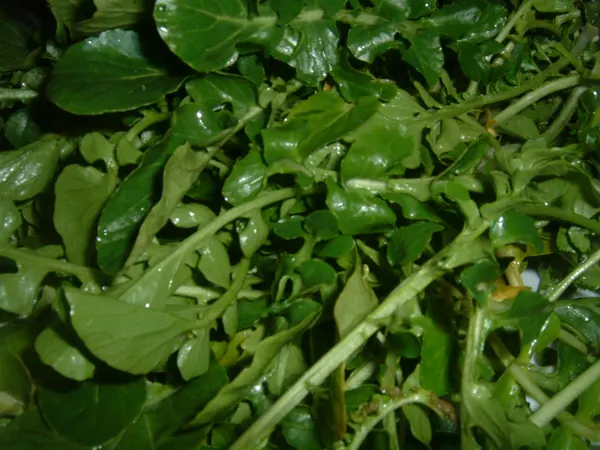
Watercress
Nasturtium officinale
Other names: Watercress
Edible plantPhoto credit: Masparasol
This plant carries serious safety risks. All information is for educational reference only.
Safety information
Toxicity: Low intrinsic toxicity. Major foraging hazard: wild watercress in pastures grazed by sheep/cattle can carry larvae (metacercariae) of liver fluke Fasciola hepatica, causing human fascioliasis (WHO). Wild-foraged watercress should be cooked, not eaten raw; commercial is grown in controlled water.
Contraindications: Pregnancy (traditional caution at high/medicinal amounts); avoid raw wild watercress in fluke-endemic grazing areas.
Interactions: High vitamin K may antagonise warfarin (consistency matters); glucosinolate/isothiocyanate effects on drug metabolism theoretical.
Pregnancy & breastfeeding: Pregnancy (traditional caution at high/medicinal amounts).
Evidence level
Reported in folk medicine sources; not clinically validated. Folk and historical sources have not been validated by clinical research.
Preparations
This plant carries serious safety risks. All information is for educational reference only.
edible-raw · leaf/stem
Part used: leaf/stem
Traditional use: salad (peppery) — see fluke caveat(Folk and historical sources have not been validated by clinical research.)
cooked · leaf/stem
Part used: leaf/stem
Traditional use: soup — for wild-foraged material to kill liver-fluke larvae(Folk and historical sources have not been validated by clinical research.)
Proposed mechanism: cooking kills Fasciola metacercariae
Associated conditions
Edibility
Edible parts: Leaves/stems; wild-foraged: cook to kill liver-fluke larvae.
Toxic lookalike warning
Confused, sometimes fatally, with fool's watercress and especially the lethal water-dropworts (Oenanthe spp., e.g. O. crocata) and lesser water-parsnip in the same streams; watercress has rounded, pinnate, peppery-tasting leaves and hollow floating stems, Oenanthe has finely divided carrot-like leaves. Never harvest cress from water where umbellifer foliage is present.
Nutritional notes
Exceptionally high in vitamin K, vitamin C, vitamin A (carotenoids), with glucosinolate-derived isothiocyanates (e.g. PEITC); among the most nutrient-dense vegetables per calorie. Functional brassica green.
Healing traditions
Related plants
Sources (3)
- brassica glucosinolate food-composition literature
- WHO foodborne trematodiases / fascioliasis fact sheet
- USDA FoodData Central (watercress, raw)