
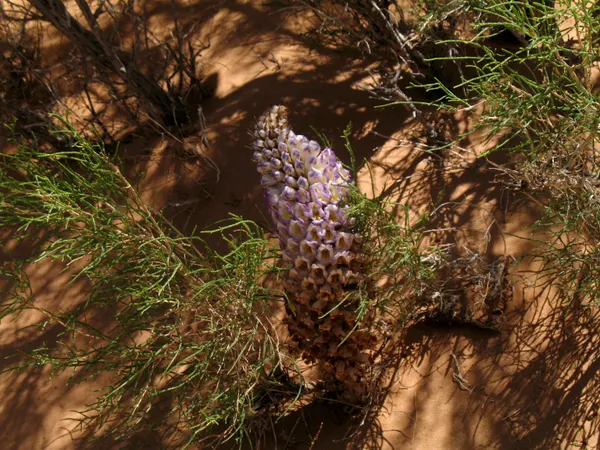
Desert-broomrape / rou cong rong (肉苁蓉)
Cistanche deserticola
Edible plantPhoto credit: Yanish E
Safety information
Safety information
Toxicity: Low; well tolerated in animal studies.
Contraindications: Loose stools/diarrhea, yin-deficient heat (TCM); damp-heat patterns.
Interactions: None well documented.
Evidence level
Supported by laboratory or animal studies; not yet confirmed in humans.
Preparations
wine-processed · fleshy stem
Part used: fleshy stem
in formula · fleshy stem
Part used: fleshy stem
decoction · fleshy stem
Part used: fleshy stem
Traditional use: tonifies kidney yang, supplements essence and blood, moistens intestines; impotence, infertility, lumbar weakness, senile constipation
Proposed mechanism: phenylethanoid glycosides (echinacoside, acteoside), polysaccharides — neuroprotective, immunomodulatory, anti-fatigue, laxative
Associated conditions
Edibility
Edible parts: Fleshy stem used as a tonic food/soup ingredient in some regions; not a common raw food.
Nutritional notes
Polysaccharides, phenylethanoid glycosides (functional-tonic role).
Healing traditions
Related plants
Sources (1)
- [E9] Herba Cistanche (Rou Cong-Rong) phytochemistry & pharmacology review (Front. Pharmacol.)
Sourcing & resources
Affiliate links — we may earn a small commission at no extra cost to you.