
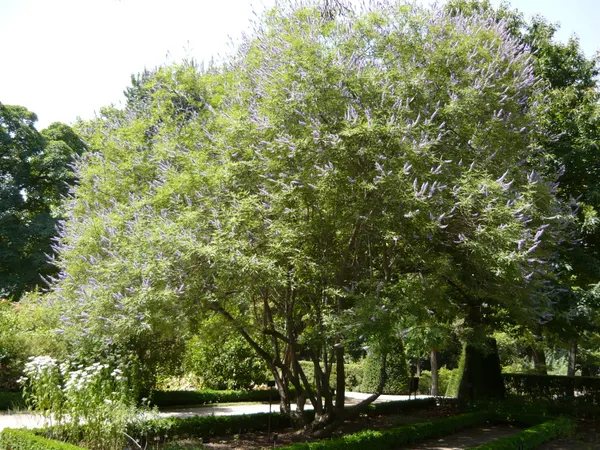
Chaste Tree
Vitex agnus-castus
Other names: Chaste Tree, Vitex (Chaste Tree)
Edible plantPhoto credit: Cillas
Safety information
Safety information
Toxicity: Mild — excess can cause a crawling skin sensation (formication); occasional GI upset/headache. | None known reported.
Contraindications: Avoid in pregnancy; not advisable with the contraceptive pill or fertility treatment. | None specifically named.
Interactions: Hormonal contraceptives and fertility drugs (interferes with hormonal action). | Commission E lists none, but theoretical interaction with dopamine antagonists and dopamine-receptor-blocking agents.
Pregnancy & breastfeeding: Avoid in pregnancy.
Evidence level
Supported by clinical trials in humans.
Preparations
tincture · fruit
Part used: fruit
Traditional use: To regulate an irregular menstrual cycle.
How to prepare (traditional): A tincture is made from the berries.
Dosage note (descriptive only): For an irregular cycle, 40 drops with water daily for 3 months.
other · fruit
Part used: fruit
Traditional use: For premenstrual syndrome.
How to prepare (traditional): Made into tablets.
Dosage note (descriptive only): Taken for premenstrual syndrome.
Associated conditions
Edibility
Edible parts: berry used as a pepper-like spice (monk's pepper)
Nutritional notes
Not a food. | Minor culinary use.
Healing traditions
Related plants
Sources (2)
- Chevallier A., Encyclopedia of Herbal Medicine (2016) — Andrew Chevallier (2016)
- Hoffmann D., Medical Herbalism (2003) — David Hoffmann (2003)
Sourcing & resources
Affiliate links — we may earn a small commission at no extra cost to you.