
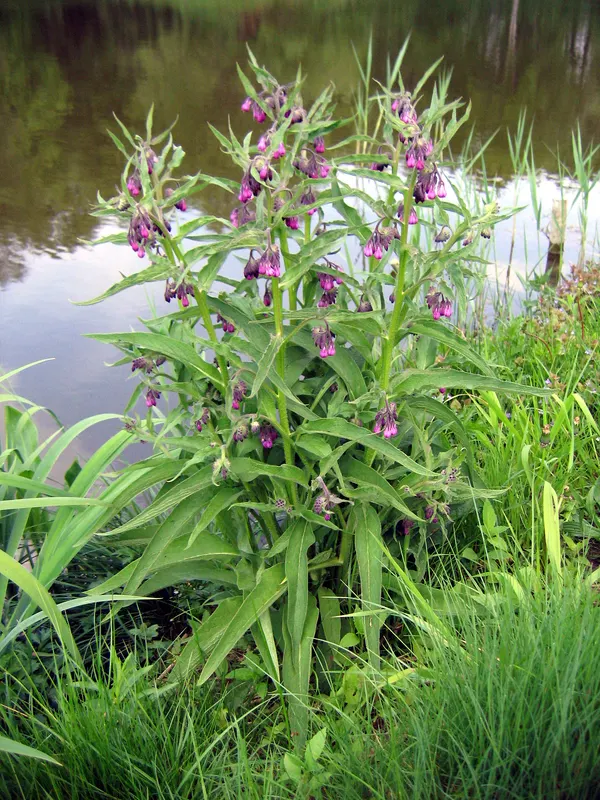
This plant carries serious safety risks. All information is for educational reference only.
Safety information
Toxicity: SERIOUS (modern). Contains pyrrolizidine alkaloids which are hepatotoxic (veno-occlusive liver disease) and potentially carcinogenic. Internal use restricted/banned in many countries; root more alkaloid-rich than leaf. | Serious (internal) — pyrrolizidine alkaloids (echimidine, symphytine) hepatotoxic/carcinogenic/mutagenic; potentially genotoxic carcinogen. Only slight absorption with external use. | Contains hepatotoxic pyrrolizidine alkaloids (PAs) — internal use can cause cumulative liver damage (veno-occlusive disease), PAs genotoxic/carcinogenic; root far higher in PAs than leaf. Topical use over broken skin/large areas allows some absorption.
Contraindications: Pregnancy, breastfeeding, liver disease; not for internal use (modern). None specified by Grieve. | Avoid lengthy internal use; avoid on very deep wounds (can seal over → abscess); avoid internal use in pregnancy/lactation. | Internal use: contraindicated, especially in pregnancy/breastfeeding (PAs cross placenta/milk), children, and liver disease. Topical: avoid on broken skin, do not use long-term or on large areas.
Interactions: None specified by source; avoid with other hepatotoxic agents (modern). | None specifically reported (PA hepatotoxicity additive with other PA herbs/hepatotoxins). | Additive hepatotoxicity with other PA sources (coltsfoot, borage) and hepatotoxic drugs.
Pregnancy & breastfeeding: Avoid (modern). | Avoid internal use in pregnancy/lactation. | Internal use contraindicated (PAs cross placenta/milk).
Evidence level
Supported by clinical trials in humans.
Preparations
This plant carries serious safety risks. All information is for educational reference only.
poultice · leaf
Part used: leaf
Traditional use: Traditionally applied to boils (external use only).
How to prepare (traditional): Leaves are chopped and applied as a poultice.
Dosage note (descriptive only): professional use only — not provided
Reference only — not a dosage instruction
oil · leaf
Part used: leaf
Traditional use: Applied externally to sprains.
How to prepare (traditional): An infused oil is made from the leaves.
Dosage note (descriptive only): professional use only — not provided
Reference only — not a dosage instruction
other · leaf
Part used: leaf
Traditional use: Applied externally to bruises.
How to prepare (traditional): Leaves are made into an ointment.
Dosage note (descriptive only): professional use only — not provided
Reference only — not a dosage instruction
tincture · root
Part used: root
Traditional use: Applied undiluted to acne (external).
How to prepare (traditional): A tincture is made from the root.
Dosage note (descriptive only): professional use only — not provided
Reference only — not a dosage instruction
Associated conditions
Edibility
Edible parts: young leaves cooked as spinach substitute, blanched shoots (historically; now discouraged due to PA hepatotoxicity) | Not a food (despite historical leaf-eating, now considered unsafe due to PAs)
Toxic lookalike warning
Comfrey leaves can be confused with Foxglove (Digitalis, deadly); comfrey leaves have isolated stiff hairs and veins not extending into the leaf-stalk wings.
Nutritional notes
Root very high in mucilage; leaves a traditional green (now discouraged). | Not for consumption. | Not recommended as a food (PA risk outweighs any nutrient content).
Healing traditions
Related plants
- Daruharidra (tree turmeric / Indian barberry)Berberis aristataClinical
- Musta (nutgrass)Cyperus rotundusClinical
- Khadira (black catechu / cutch tree)Acacia catechuClinical
- Kalgan / TormentilPotentilla erectaClinical
- Sangre de grado / Dragon's bloodCroton lechleriClinical
- Amur cork tree bark / huang bai (黄柏)Phellodendron amurenseClinical
Sources (3)
- Grieve M., A Modern Herbal (1931) — Maud Grieve (1931)
- Hoffmann D., Medical Herbalism (2003) — David Hoffmann (2003)
- Bussmann et al., A comparative ethnobotany ... Republic of Georgia, J Ethnobiol Ethnomed 2016;12:43