
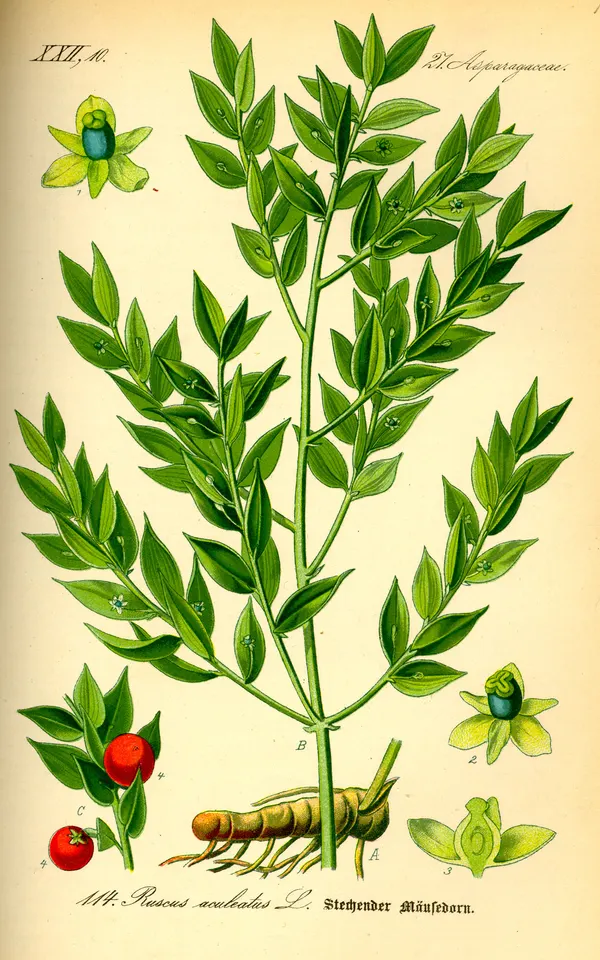
Butcher's broom
Ruscus aculeatus
Other names: knee holly, box holly, Rusci aculeati rhizoma
Edible plantPhoto credit: Wikimedia Commons
Safety information
Safety information
Toxicity: Low; occasional mild GI upset (nausea) reported.
Contraindications: Pregnancy/lactation: insufficient data, not recommended. Children/adolescents under 18: not recommended. Hypersensitivity.
Interactions: Few documented. Theoretical interaction with antihypertensives or alpha-adrenergic agents via vasoconstrictor activity - limited evidence; caution in hypertension.
Pregnancy & breastfeeding: not recommended in pregnancy/lactation (insufficient data)
Evidence level
Documented in systematic traditional medicine literature.
Preparations
dry extract · rhizome
Part used: rhizome
Traditional use: chronic venous insufficiency, haemorrhoid symptoms
Proposed mechanism: steroidal saponins (ruscogenin, neoruscogenin) - venotonic/vasoconstrictor, anti-inflammatory
Associated conditions
Edibility
Edible parts: young shoots have historically been eaten like asparagus in parts of the Mediterranean, but the plant is spiny and the rhizome is the medicinal part; the red berries are not recommended for eating
Toxic lookalike warning
identify carefully (spiny leaves are flattened stems/cladodes); red berries not recommended for eating
Nutritional notes
not a nutritional source
Healing traditions
Related plants
Sources (2)
- Current Insights into the Phytochemistry and Pharmacological Properties of Ruscus aculeatus (PMC)
- EMA - final assessment report on Ruscus aculeatus L., rhizoma (Revision 1) (EMA/HMPC)
Sourcing & resources
Affiliate links — we may earn a small commission at no extra cost to you.