
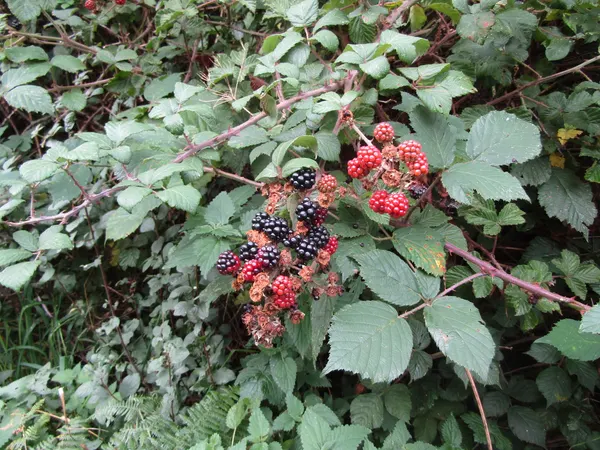
Blackberry / bramble
Rubus(?)
Other names: Blackberry / bramble
Edible plantPhoto credit: Kolforn ( Kolforn )
Safety information
Safety information
Toxicity: None known as food. Leaf tea is mild; tannins.
Contraindications: None well established; high-tannin leaf tea may cause mild GI upset/constipation in sensitive people.
Interactions: Tannins may reduce iron/drug absorption if taken together in large amounts.
Evidence level
Supported by laboratory or animal studies; not yet confirmed in humans.
Preparations
edible-raw · ripe berry
Part used: ripe berry
Traditional use: eaten fresh(Folk and historical sources have not been validated by clinical research.)
cooked · fruit
Part used: fruit
Traditional use: jam, tklapi/leather, sauces(Folk and historical sources have not been validated by clinical research.)
infusion · leaf
Part used: leaf
Traditional use: astringent folk tea for sore throat, mouth rinse, mild diarrhea
Proposed mechanism: anthocyanins, ellagitannins; leaf astringency
Associated conditions
Edibility
Edible parts: ripe berries raw/cooked; young leaves for tea
Toxic lookalike warning
Aggregate blackberry fruit is distinctive, but confirm the thorny arching bramble and aggregate drupelet fruit; avoid unknown dark aggregate or single berries.
Nutritional notes
Vitamin C, vitamin K, manganese, folate, anthocyanins and ellagitannins, fibre — high in antioxidants for a temperate fruit.
Healing traditions
Related plants
- Daruharidra (tree turmeric / Indian barberry)Berberis aristataClinical
- Musta (nutgrass)Cyperus rotundusClinical
- Khadira (black catechu / cutch tree)Acacia catechuClinical
- Kalgan / TormentilPotentilla erectaClinical
- Sangre de grado / Dragon's bloodCroton lechleriClinical
- Amur cork tree bark / huang bai (黄柏)Phellodendron amurenseClinical
Sources (2)
- Bussmann et al., A comparative ethnobotany ... Republic of Georgia, J Ethnobiol Ethnomed 2016;12:43
- Bussmann et al., Unity in diversity — food plants of Sakartvelo, 2021
Sourcing & resources
Affiliate links — we may earn a small commission at no extra cost to you.