
Safety information
Safety information
Toxicity: None known; a mild, safe astringent herb. | Generally low-toxicity at traditional/tea doses; comprehensive human safety data limited.
Contraindications: None specified by source. | Traditional caution in spleen/stomach deficiency-cold; pregnancy/clinical data limited; theoretical caution with antihypertensive/antidiabetic drugs.
Interactions: None specified by source. | Theoretical additive effects with antihypertensive and antidiabetic agents; not well characterized.
Pregnancy & breastfeeding: Data limited.
Evidence level
Supported by laboratory or animal studies; not yet confirmed in humans.
Preparations
infusion, gargle (with honey), injection/enema for internal bleeding and piles, bruised herb as a wound salve (historical) · whole herb
Part used: whole herb
Traditional use: general strengthener, sore/relaxed throat and ulcerated mouth (gargle), internal bleeding and piles, wound herb(Folk and historical sources have not been validated by clinical research.)
Proposed mechanism: astringent, styptic, tonic; lab interest exists but claims not clinically established
decoction · flower spike
Part used: flower spike
Traditional use: clearing liver heat, brightening eyes, dispersing nodules/swellings (red eyes, headache, phlegm-fire lumps such as goitre/scrofula)
Proposed mechanism: triterpenes (ursolic/oleanolic acid), rosmarinic acid, sulfated polysaccharide (prunellin)
infusion · flower spike
Part used: flower spike
Traditional use: cooling drinks(Folk and historical sources have not been validated by clinical research.)
Associated conditions
Edibility
Edible parts: leaves edible raw or cooked, used in salads/teas elsewhere | Young leaves edible (Western foraging tradition); herb used in cooling teas/drinks.
Toxic lookalike warning
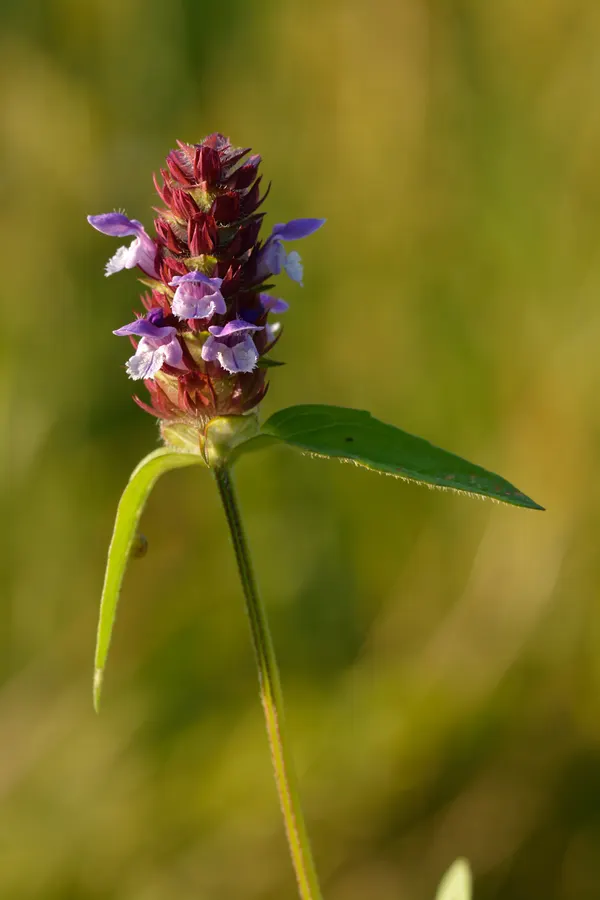
A small wild Labiate; identify by its distinctive squarish flower ear and paired stalkless leaves below it; avoid confusion with other low wild mints/labiates. | A low Lamiaceae (square stem, opposite leaves, club-like flower spike) - identify carefully and use food-grade material; avoid confusion with other small mints/labiates.
Nutritional notes
Volatile oil, a bitter principle, tannin (chief active), sugar. | Functional tea herb; rosmarinic acid, triterpenes, minerals; modest nutrient value.
Healing traditions
Related plants
Sources (3)
- Grieve M., A Modern Herbal (1931) — Maud Grieve (1931)
- Prunella vulgaris (Wikipedia), English, accessed 2026, https://en.wikipedia.org/wiki/Prunella_vulgaris
- Prunella / Self-heal - Drugs.com natural database, English, https://www.drugs.com/npp/prunella.html
Sourcing & resources
Affiliate links — we may earn a small commission at no extra cost to you.