
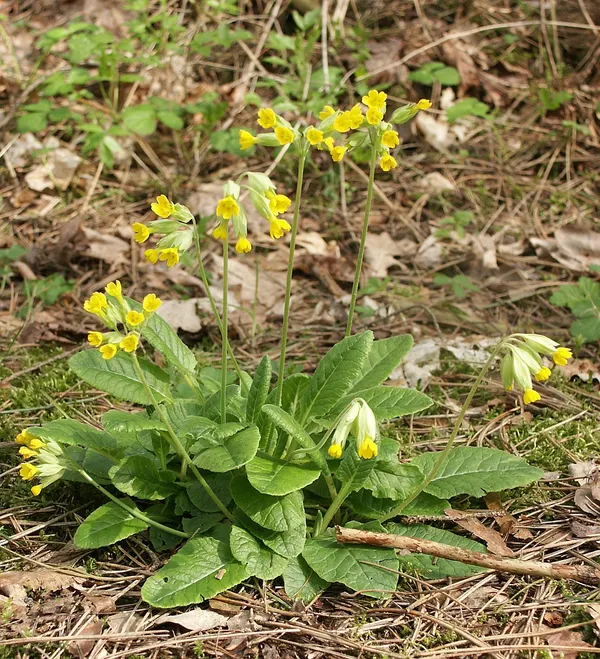
Caucasian/Georgian primrose
Primula veris(?)
Other names: Caucasian/Georgian primrose
Edible plantPhoto credit: Picture taken by BerndH
Safety information
Safety information
Toxicity: Low as food (young leaf/flower). The root is saponin-rich and can irritate the stomach in larger amounts; primulin/primin in some Primula (notably P. obconica, not the wild edible species) causes contact dermatitis ('primula dermatitis').
Contraindications: Saponin-rich root preparations: gastritis/peptic ulcer and pregnancy caution; known primula contact allergy.
Interactions: None well documented; theoretical additive with other expectorants/saponin herbs.
Pregnancy & breastfeeding: Saponin-rich root preparations: caution.
Evidence level
Supported by laboratory or animal studies; not yet confirmed in humans.
Preparations
infusion · flower/root
Part used: flower/root
Traditional use: mild expectorant for coughs, gentle calmative ('for sleep/nerves')
Proposed mechanism: root saponins expectorant
edible-raw/cooked · young leaf/flower
Part used: young leaf/flower
Traditional use: among the first spring greens — salads or cooked(Folk and historical sources have not been validated by clinical research.)
Dosage note (descriptive only): young only
Associated conditions
Edibility
Edible parts: young leaves and flowers raw or cooked (older leaves toughen)
Toxic lookalike warning
CRITICAL: before flowering, Primula rosettes can be confused with foxglove (Digitalis) rosettes, which are deadly (cardiac glycosides) — both form wrinkled basal rosettes; confirm the primrose by its primrose flowers and crinkled tapering leaf, and never gather rosette leaves of an unflowered plant you cannot identify.
Nutritional notes
Young leaves provide vitamin C and minerals; flowers a low-calorie edible garnish; modest leafy-green value.
Healing traditions
Related plants
Sources (2)
- Bussmann et al., A comparative ethnobotany ... Republic of Georgia, J Ethnobiol Ethnomed 2016;12:43
- Bussmann et al., Unity in diversity — food plants of Sakartvelo, 2021
Sourcing & resources
Affiliate links — we may earn a small commission at no extra cost to you.