
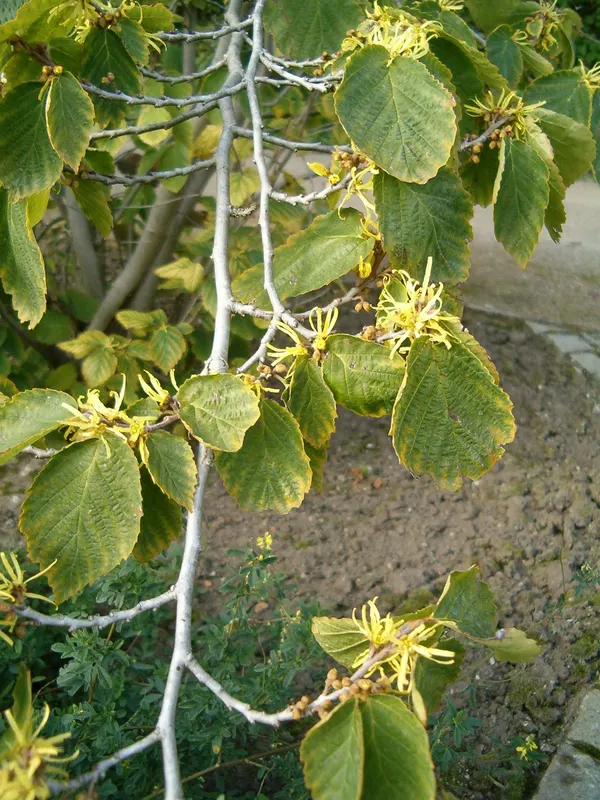
Witch Hazel
Hamamelis virginiana
Other names: Witch Hazel
Photo credit: Wikimedia Commons contributor
Safety information
Safety information
Toxicity: Topical: occasional contact allergy/skin irritation. Oral use not recommended (tannins can cause stomach upset/liver concern in excess); products for external/local use.
Contraindications: Hypersensitivity to the plant. EMA age limits by preparation (many external preparations >6 or >12). External use only.
Interactions: None established for topical use.
Pregnancy & breastfeeding: Not specifically addressed.
Evidence level
Documented in systematic traditional medicine literature.
Preparations
infusion · twig and leaf
Part used: twig and leaf
Traditional use: Traditionally used as an astringent for bleeding (internal and external), haemorrhoids, bruises, inflamed swellings and varicose veins, and for diarrhoea/dysentery.
How to prepare (traditional): Infusion: pour 1 cup of boiling water over 1 teaspoon of dried herb and infuse 10-15 minutes. Most commonly found and used as distilled witch hazel and in ointments and other topical formulations.
Dosage note (descriptive only): Drunk three times a day.
tincture · twig and leaf
Part used: twig and leaf
Traditional use: Astringent.
How to prepare (traditional): Tincture at 1:5 in 40% alcohol.
Dosage note (descriptive only): 1-2 ml three times a day.
tincture · bark
Part used: bark
Traditional use: Traditionally applied externally to varicose veins.
How to prepare (traditional): Tincture of the bark diluted in cold water and sponged onto the skin.
Dosage note (descriptive only): The book suggests diluting 1 tbsp in 1/2 cup (100 ml) cold water and sponging onto varicose veins.
other · leaf
Part used: leaf
Traditional use: Traditionally applied to insect stings, sore skin and broken veins.
How to prepare (traditional): Distilled witch hazel (leaves and young twigs distilled), dabbed onto the skin.
Dosage note (descriptive only): Dabbed onto insect stings, sore skin, and broken veins.
other · bark
Part used: bark
Traditional use: Traditionally applied to hemorrhoids.
How to prepare (traditional): Ointment of the bark.
Dosage note (descriptive only): The book suggests applying to hemorrhoids twice a day.
infusion · leaf
Part used: leaf
Traditional use: Traditionally applied externally for broken veins and cysts.
How to prepare (traditional): Infusion of the leaves, used as a lotion.
Dosage note (descriptive only): Used as a lotion for broken veins and cysts.
Associated conditions
Nutritional notes
Not relevant.
Healing traditions
Related plants
Sources (1)
- EMA/HMPC Hamamelidis folium / cortex / aqua monograph & public summary
Sourcing & resources
Affiliate links — we may earn a small commission at no extra cost to you.