
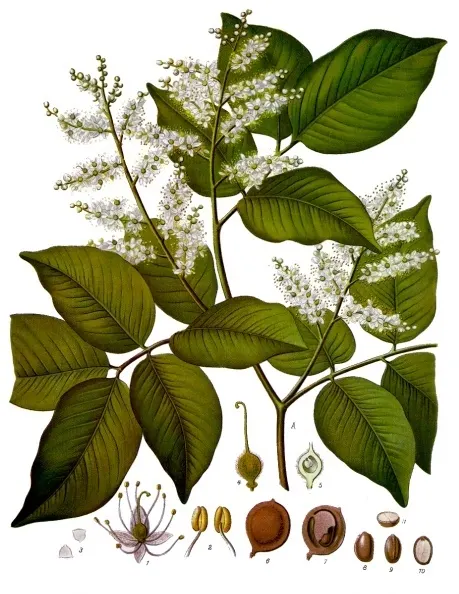
Copaiba
Copaifera officinalis
Photo credit: Franz Eugen Köhler, Köhler's Medizinal-Pflanzen
Safety information
Safety information
Toxicity: Oleoresin generally well tolerated topically at usual amounts; oral/high doses can cause GI upset, and large doses are associated with skin rash and possible kidney irritation. Quality/species/composition varies considerably.
Contraindications: Pregnancy and lactation (insufficient data); known balsam/resin allergy; caution with oral use in renal impairment.
Interactions: Limited formal data; theoretical additive effects with anti-inflammatory agents; possible CYP interaction (terpene content).
Pregnancy & breastfeeding: Pregnancy and lactation: insufficient data.
Evidence level
Supported by laboratory or animal studies; not yet confirmed in humans.
Preparations
oral drops (folk); essential oil · oleoresin
Part used: oleoresin
topical oleoresin/oil applied to skin and wounds · oleoresin
Part used: oleoresin
Traditional use: wound healing, ulcers and skin lesions, anti-inflammatory and analgesic, leishmaniasis wounds; folk on newborn navels and warriors' wounds
Proposed mechanism: beta-caryophyllene (CB2 agonist) and alpha-humulene — anti-inflammatory and tissue repair
Associated conditions
Nutritional notes
Not relevant (resin/essential oil).
Healing traditions
Related plants
Sources (2)
- Safety and Effectiveness of Copaiba Oleoresin on Oral Wounds in Rats, PMC7278981, 2020
- Anti-inflammatory and wound healing effect of Copaiba systematic review, PMC8873535, 2022
Sourcing & resources
Affiliate links — we may earn a small commission at no extra cost to you.