
Sweet chestnut
Castanea sativa
Other names: Sweet chestnut
Edible plantPhoto credit: Wikimedia Commons contributor
Safety information
Safety information
Toxicity: Edible sweet-chestnut nut: none known (a true nut, not the inedible toxic horse-chestnut). Leaf/bark high in tannins — concentrated internal use astringent.
Contraindications: Tree-nut allergy; none otherwise well established for the nut.
Interactions: High-tannin leaf preparations may reduce iron/drug absorption; minimal for the food nut.
Evidence level
Supported by laboratory or animal studies; not yet confirmed in humans.
Preparations
decoction · leaf
Part used: leaf
Traditional use: folk for cough/sore throat (astringent)
Proposed mechanism: leaf tannins/flavonoids
cooked · nut
Part used: nut
Traditional use: roasted, boiled, flour, in stews and sweets(Folk and historical sources have not been validated by clinical research.)
Dosage note (descriptive only): cook
Associated conditions
Edibility
Edible parts: nuts cooked (roasted/boiled; raw is hard and tannic)
Toxic lookalike warning
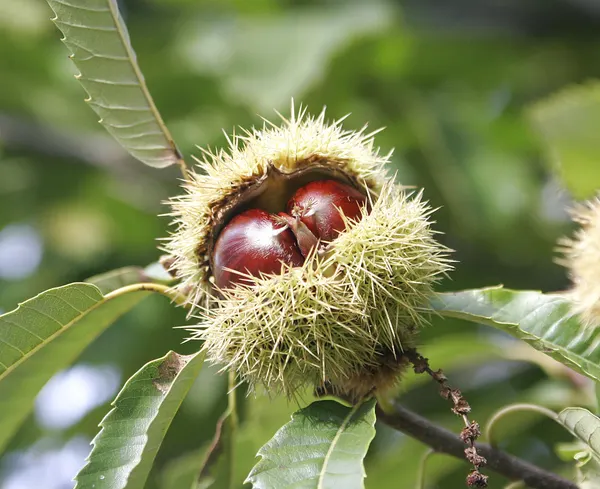
CRITICAL: do not confuse sweet chestnut (Castanea sativa) with the toxic horse-chestnut/conker (Aesculus hippocastanum) — conkers are toxic (aescin/saponins). Sweet chestnuts have a very spiny green burr with several flattened nuts and a tassel/point on the nut and toothed simple leaves; horse-chestnut has a leathery few-spined husk, a single rounded smooth nut, and palmate compound leaves. Eat only confirmed sweet chestnut.
Nutritional notes
Unusual among nuts — low in fat, high in complex carbohydrate/starch and fibre, with vitamin C (notable for a nut), B vitamins, potassium, magnesium and manganese; gluten-free flour. A starchy staple-type tree food.
Healing traditions
Related plants
Sources (2)
- Bussmann et al., A comparative ethnobotany ... Republic of Georgia, J Ethnobiol Ethnomed 2016;12:43
- Bussmann et al., Unity in diversity — food plants of Sakartvelo, 2021
Sourcing & resources
Affiliate links — we may earn a small commission at no extra cost to you.