
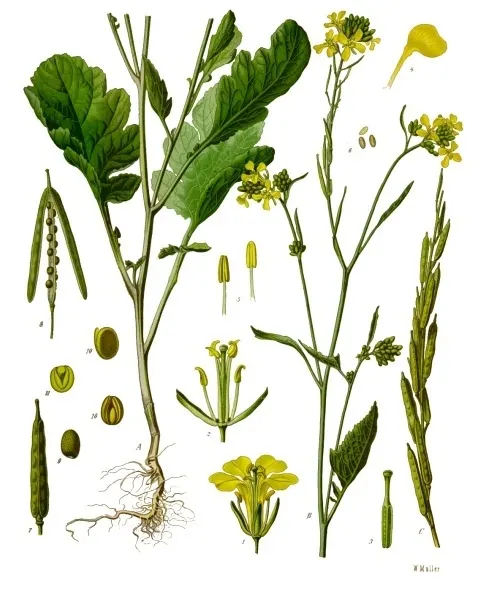
Black Mustard
Brassica nigra
Other names: Black Mustard
Edible plantPhoto credit: Walther Otto Müller, Köhler's Medizinal-Pflanzen
Safety information
Safety information
Toxicity: May cause skin irritation when applied externally, especially in fair-skinned people.
Contraindications: Avoid prolonged skin contact (blistering risk).
Interactions: None reported.
Evidence level
Documented in systematic traditional medicine literature.
Preparations
poultice · seed
Part used: seed
Traditional use: Traditionally used as a stimulating rubefacient poultice for muscular/skeletal pain, chilblains and bronchitis.
How to prepare (traditional): Poultice: mix about 100 g of freshly ground mustard seeds with enough warm water (~45 C / 110 F) to form a thick paste; spread on cloth, first laying dampened gauze on the skin to prevent sticking, apply and remove after about 1 minute; soothe afterward with olive oil. A footbath uses 1 tablespoon of bruised seeds to 1 litre of boiling water.
Dosage note (descriptive only): External use; remove after about 1 minute to avoid over-irritation.
infusion · seed
Part used: seed
Traditional use: Internal diaphoretic for feverishness, colds and influenza.
How to prepare (traditional): Infusion: pour 1 cup of boiling water over 1 teaspoon of mustard flour (powder) and infuse 5 minutes.
Dosage note (descriptive only): May be drunk three times a day.
Associated conditions
Edibility
Edible parts: mustard seed is a culinary condiment/spice; leaves eaten as greens
Nutritional notes
Culinary condiment.
Healing traditions
Related plants
Sources (1)
- Hoffmann D., Medical Herbalism (2003) — David Hoffmann (2003)
Sourcing & resources
Affiliate links — we may earn a small commission at no extra cost to you.