
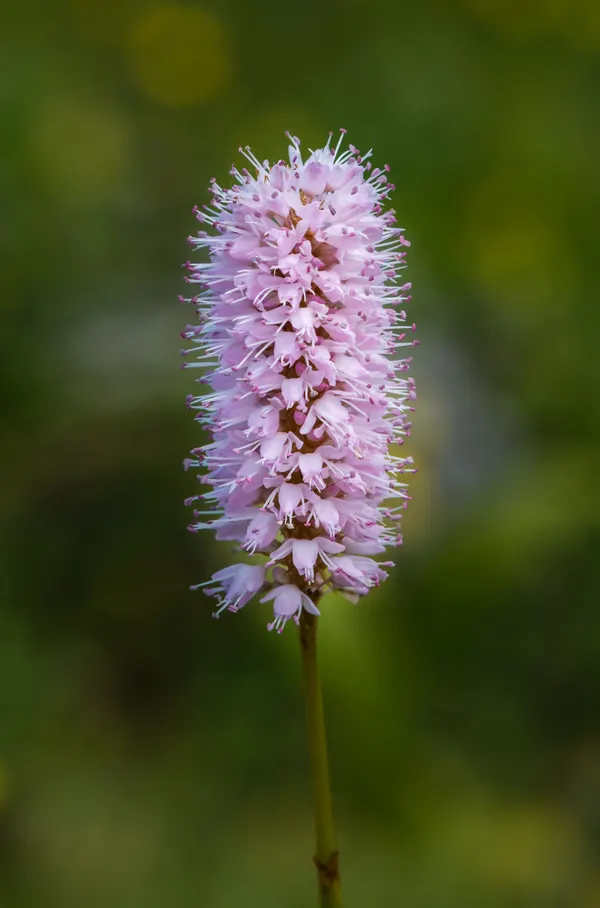
Common bistort / snakeweed
Bistorta officinalis
Other names: highland greens names, Common bistort / snakeweed
Edible plantPhoto credit: Uoaei1 (Wikimedia Commons)
Safety information
Safety information
Toxicity: Young leaves: low as a cooked green; like other Polygonaceae they contain oxalates — moderate intake. Rhizome very high in tannins — astringent, not for prolonged high-dose internal use.
Contraindications: Kidney stones (oxalate) — limit; high-tannin rhizome not for prolonged use or with iron-deficiency; pregnancy not established for medicinal rhizome.
Interactions: Tannins reduce iron/drug/alkaloid absorption taken together; astringent rhizome theoretical additive constipating effect.
Pregnancy & breastfeeding: Medicinal rhizome not established.
Evidence level
Supported by laboratory or animal studies; not yet confirmed in humans.
Preparations
decoction · rhizome
Part used: rhizome
Traditional use: strong astringent for diarrhea, sore throat, wounds ('snakeweed')
Proposed mechanism: very high tannin astringency; antioxidant
Dosage note (descriptive only): not for prolonged high-dose internal use
cooked · young leaf/shoot
Part used: young leaf/shoot
Traditional use: spring greens/fillings (bistort-and-herb pies)(Folk and historical sources have not been validated by clinical research.)
Dosage note (descriptive only): young only
Associated conditions
Edibility
Edible parts: young leaves/shoots cooked
Toxic lookalike warning
Confirm Bistorta (basal long-stalked leaves, characteristic pink 'bottlebrush' flower spike, ochrea/sheath at leaf nodes typical of Polygonaceae) and avoid unknown meadow rosette leaves; do not dig unknown rhizomes.
Nutritional notes
Young leaves provide vitamin C, provitamin-A and minerals; tannins and (modest) oxalate — a seasonal cooked green.
Healing traditions
Related plants
- Daruharidra (tree turmeric / Indian barberry)Berberis aristataClinical
- Musta (nutgrass)Cyperus rotundusClinical
- Khadira (black catechu / cutch tree)Acacia catechuClinical
- Kalgan / TormentilPotentilla erectaClinical
- Sangre de grado / Dragon's bloodCroton lechleriClinical
- Amur cork tree bark / huang bai (黄柏)Phellodendron amurenseClinical
Sources (2)
- Bussmann et al., A comparative ethnobotany ... Republic of Georgia, J Ethnobiol Ethnomed 2016;12:43
- Bussmann et al., Unity in diversity — food plants of Sakartvelo, 2021
Sourcing & resources
Affiliate links — we may earn a small commission at no extra cost to you.