
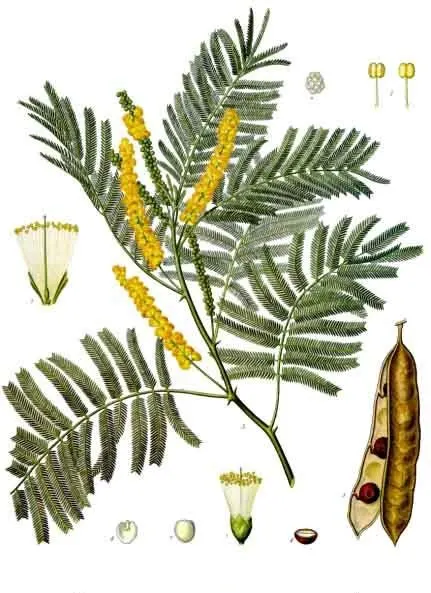
Khadira (black catechu / cutch tree)
Acacia catechu
Edible plantPhoto credit: Franz Eugen Köhler, Köhler's Medizinal-Pflanzen
Safety information
Safety information
Toxicity: Low at studied/food-adjacent doses; high tannin can cause GI upset/constipation.
Contraindications: Pregnancy (high-dose — caution); constipation; iron-deficiency (tannins bind iron).
Interactions: Tannins reduce absorption of iron, alkaloids and some drugs if co-administered; possible additive with antidiabetics.
Pregnancy & breastfeeding: Pregnancy: high-dose — caution.
Evidence level
Supported by clinical trials in humans.
Preparations
decoction · heartwood
Part used: heartwood
powder · heartwood
Part used: heartwood
lozenges/mouthwash · heartwood
Part used: heartwood
Traditional use: oral health
dried heartwood extract (katha/catechu) · heartwood
Part used: heartwood
Traditional use: skin disease, sore throat, mouth ulcers, diarrhea, wounds
Proposed mechanism: catechin and epicatechin (flavan-3-ols), tannins — astringent, antioxidant, anti-inflammatory, antimicrobial, antidiarrheal
Associated conditions
Edibility
Edible parts: Katha (the extract) used in trace amounts in betel paan and as a food colorant/astringent; not eaten in quantity.
Toxic lookalike warning
Many Acacia/Senegalia species look alike and some have other alkaloids — use authenticated catechu only.
Nutritional notes
Source of catechins (flavan-3-ols); not a staple food.
Healing traditions
Related plants
- Daruharidra (tree turmeric / Indian barberry)Berberis aristataClinical
- Musta (nutgrass)Cyperus rotundusClinical
- Kalgan / TormentilPotentilla erectaClinical
- Sangre de grado / Dragon's bloodCroton lechleriClinical
- Amur cork tree bark / huang bai (黄柏)Phellodendron amurenseClinical
- BaelAegle marmelosClinical
Sources (2)
- Sunil 2022, Foods/Plants review (PMID 36432824)
- Stohs 2015, Phytother Res (PMID 25802170)
Sourcing & resources
Affiliate links — we may earn a small commission at no extra cost to you.