
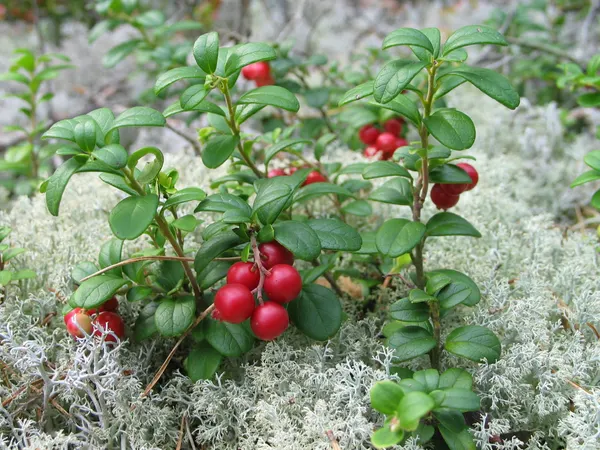
Brusnika / Lingonberry (cowberry)
Vaccinium vitis-idaea
Edible plantPhoto credit: Jonas Bergsten
Safety information
Safety information
Toxicity: Mild. Leaf arbutin/hydroquinone -> avoid prolonged/high-dose use (hydroquinone concern); tannins can cause GI upset.
Contraindications: Leaf tea: pregnancy/lactation and children (arbutin/hydroquinone — avoid); kidney disease/acute nephritis; prolonged use discouraged. Berries: generally safe as food.
Interactions: Arbutin urinary antiseptics traditionally taken with alkaline urine; additive with diuretics; tannin-absorption caution.
Pregnancy & breastfeeding: Leaf tea: avoid in pregnancy/lactation (arbutin/hydroquinone).
Evidence level
Documented in systematic traditional medicine literature.
Preparations
leaf infusion/decoction (urinary tea) · leaves
Part used: leaves
Traditional use: mild diuretic/urinary antiseptic for cystitis and to flush the urinary tract, kidney 'stones'
Proposed mechanism: leaves contain arbutin (-> hydroquinone, urinary-antiseptic basis, shared with bearberry), tannins, flavonoids
Dosage note (descriptive only): avoid prolonged/high-dose use
fruit eaten, juice, mors, preserves · fruit
Part used: fruit
Traditional use: vitamin and fever/cold remedy
Proposed mechanism: fruit rich in benzoic acid (natural preservative), vitamin C, anthocyanins
Associated conditions
Edibility
Edible parts: Berries, raw or cooked (tart; excellent keeping quality due to benzoic acid); leaves are for tea/medicine, not food.
Toxic lookalike warning
Distinguish lingonberry (shiny evergreen leaves, red berries, dotted leaf underside) from bearberry (Arctostaphylos uva-ursi) and from any unfamiliar red berries.
Nutritional notes
Berries: vitamin C, anthocyanins, organic acids; valued functional/preserve fruit.
Healing traditions
Related plants
Sources (2)
- Vaccinium vitis-idaea pharmacopoeial/folk literature
- EMA/HMPC Uvae ursi folium (arbutin-herb safety analogue)
Sourcing & resources
Affiliate links — we may earn a small commission at no extra cost to you.