
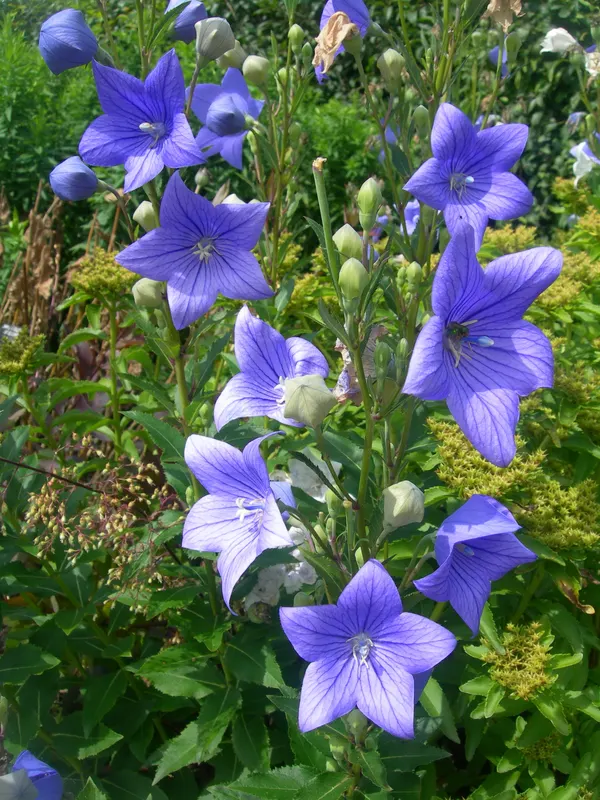
Jie geng / balloon flower
Platycodon grandiflorus
Other names: 桔梗 jiégěng; doraji, Jie geng / balloon flower
Edible plantPhoto credit: www.biolib.de
Safety information
Safety information
Toxicity: Saponin-rich; large amounts can be irritating/emetic. Generally low-toxicity at culinary/traditional amounts; saponins are why the root is blanched/soaked before eating.
Contraindications: Traditional caution in cough with hemoptysis; pregnancy/clinical data limited.
Interactions: Not well characterized; theoretical caution with strong saponin-containing combinations.
Pregnancy & breastfeeding: Data limited.
Evidence level
Supported by laboratory or animal studies; not yet confirmed in humans.
Preparations
decoction · root
Part used: root
Traditional use: opening the lung, dispersing phlegm, benefiting the throat, guiding herbs upward (cough, sore throat, phlegm)
Proposed mechanism: triterpenoid saponins (platycodins)
edible · root
Part used: root
Traditional use: Korean namul/pickle (doraji)(Folk and historical sources have not been validated by clinical research.)
Dosage note (descriptive only): blanched/soaked before eating
powder · root
Part used: root
Associated conditions
Edibility
Edible parts: Root is a popular Korean vegetable (doraji), blanched/soaked to reduce bitterness then seasoned or pickled.
Toxic lookalike warning
Showy balloon-flower plant is also ornamental; eat only authenticated culinary doraji root, never substitute unidentified foraged roots (Apiaceae/Campanulaceae confusion).
Nutritional notes
Functional vegetable; saponins, inulin, dietary fiber; modest nutrient value.
Healing traditions
Related plants
Sources (2)
- Platycodon grandiflorus (Wikipedia), English, accessed 2026, https://en.wikipedia.org/wiki/Platycodon
- Platycodon - Drugs.com natural database, English, https://www.drugs.com/npp/platycodon.html
Sourcing & resources
Affiliate links — we may earn a small commission at no extra cost to you.