
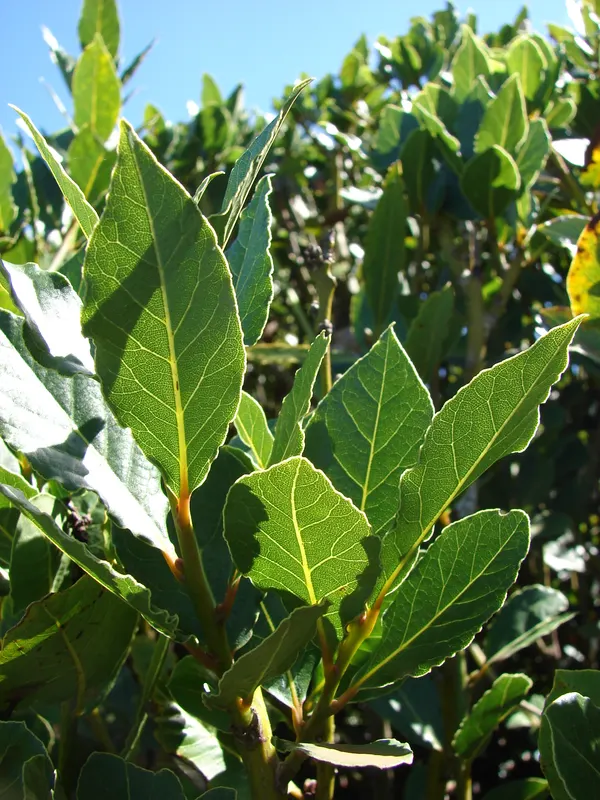
Bay laurel
Laurus nobilis
Other names: Bay laurel
Edible plantPhoto credit: Forest and Kim Starr
Safety information
Safety information
Toxicity: Culinary amounts safe; whole leaves are a choking/GI-perforation hazard if swallowed (remove before eating); very large medicinal doses not characterised.
Contraindications: Pregnancy caution at high medicinal doses (emmenagogue reputation); the '300-leaf' decoction is a large dose - not endorsed.
Interactions: Theoretical mild hypoglycaemic/sedative at high intake. (Safety gate.)
Pregnancy & breastfeeding: Caution at high medicinal doses.
Evidence level
Reported in folk medicine sources; not clinically validated. Folk and historical sources have not been validated by clinical research.
Preparations
decoction (vodka/water) · leaf
Part used: leaf
Traditional use: loose-teeth mouth rinse (15 leaves briefly boiled in vodka)(Folk and historical sources have not been validated by clinical research.)
Proposed mechanism: essential oils
with cloves · leaf
Part used: leaf
Traditional use: whooping cough and cough(Folk and historical sources have not been validated by clinical research.)
honey decoction · leaf
Part used: leaf
Traditional use: liver enlargement (300 leaves + honey + 1 L water, reduced by half, 1/2 cup at bedtime)(Folk and historical sources have not been validated by clinical research.)
Dosage note (descriptive only): large dose, not endorsed
Associated conditions
Edibility
Edible parts: Leaf used as a cooking flavouring (removed before eating, not chewed/swallowed whole).
Toxic lookalike warning
Culinary bay (Laurus nobilis) must not be confused with toxic 'laurels' such as cherry-laurel (Prunus laurocerasus, cyanogenic) or mountain-laurel (Kalmia) - use only confirmed Laurus nobilis.
Nutritional notes
Aromatic herb; trace minerals, essential oils.
Healing traditions
Related plants
Sources (1)
- ნუნუ ღლიღვაშვილი-მარგიანი, "მედეადან დღემდე" (Nunu Ghlighvashvili-margiani, "From Medea to the present day")
Sourcing & resources
Affiliate links — we may earn a small commission at no extra cost to you.