
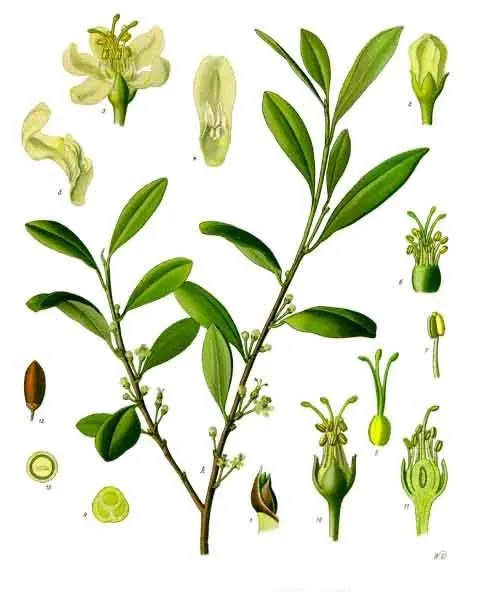
This plant carries serious safety risks. All information is for educational reference only.
Safety information
Toxicity: The leaf itself, traditionally chewed, is a mild stimulant; the isolated alkaloid cocaine (~0.6% of dried leaf, var. coca) is highly toxic and addictive with cardiovascular/CNS toxicity. The danger and legal status attach to concentration/extraction — none provided here.
Contraindications: Cardiovascular disease/arrhythmia/hypertension, pregnancy and breastfeeding, stimulant-sensitive conditions; legal prohibition in most countries.
Interactions: Additive effects with other stimulants/sympathomimetics, MAOIs, and cardioactive drugs (theoretical/alkaloid-driven).
Pregnancy & breastfeeding: Contraindicated in pregnancy and breastfeeding.
Evidence level
Supported by clinical trials in humans.
Preparations
This plant carries serious safety risks. All information is for educational reference only.
traditional leaf-chewing (acullico/coqueo) and leaf infusion (mate de coca) — general category named only; FLAGGED · leaves
Part used: leaves
Traditional use: mild stimulant for hunger/fatigue/cold suppression, altitude sickness (soroche); sacred and social plant. Distinct from cocaine
Proposed mechanism: tropane alkaloid cocaine (~0.6% of dried leaf, var. coca) — highly toxic and addictive in isolated form
Dosage note (descriptive only): NO how-to, NO quantities, NO extraction/processing
Reference only — not a dosage instruction
Associated conditions
Nutritional notes
The whole leaf contains some vitamins, calcium and other minerals and is traditionally cited as a micronutrient source in Andean diets — context only, not a dietary recommendation.
Healing traditions
Related plants
Sources (2)
- The Origins of Coca: Museum Genomics, 2021 (PMC7744036)
- Coca: The History and Medical Significance of an Ancient Andean Tradition, 2016 (PMC4838786)