
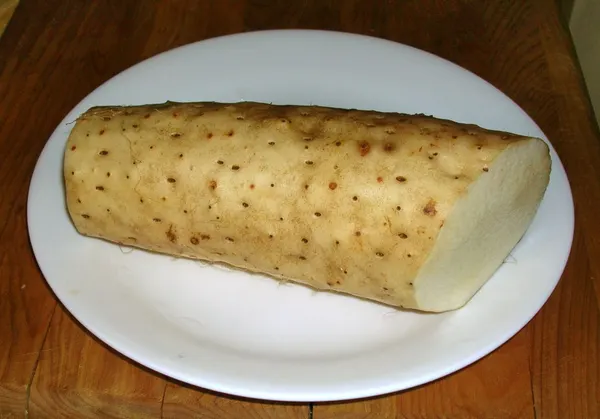
Chinese yam / shan yao
Dioscorea polystachya
Other names: 山药 / 山藥 shānyào; 怀山 huáishān; nagaimo, Chinese yam / shan yao
Edible plantPhoto credit: Wikimedia Commons contributor
Safety information
Safety information
Toxicity: Low for the food tuber. Skin/peel contains oxalate crystals that can irritate skin when peeled raw (wear gloves; vinegar/lemon helps).
Contraindications: Few for culinary amounts; clinical/pregnancy medicinal-dose data limited.
Interactions: Not well characterized.
Pregnancy & breastfeeding: Data limited (medicinal dose).
Evidence level
Documented in systematic traditional medicine literature.
Preparations
decoction · tuber/rhizome
Part used: tuber/rhizome
Traditional use: tonic formulas
edible · tuber
Part used: tuber
Traditional use: gentle tonic, strengthens spleen/lung/kidney; food-medicine(Folk and historical sources have not been validated by clinical research.)
Proposed mechanism: mucilage (soluble fiber/glycoproteins), starch
Associated conditions
Edibility
Edible parts: One of few yams whose tuber can be eaten raw (grated as Japanese tororo); also steamed/fried/in soups.
Toxic lookalike warning
Most Dioscorea yams are toxic raw and must be cooked; aerial bulbils/vines resemble invasive air-potato (D. bulbifera, toxic) and bindweed/morning-glory vines; positively identify D. polystachya before eating, never eat raw any unconfirmed yam.
Nutritional notes
Functional starchy food; mucilaginous (soluble fiber/glycoproteins), starch; staple-adjacent tuber across East Asia.
Healing traditions
Related plants
- Tibetan anisodus / 'Tang-chu-tang'Anisodus tanguticusClinical
- Siberian Ginseng (Eleuthero)Eleutherococcus senticosusClinical
- Liquorice / LicoriceGlycyrrhiza glabraClinical
- Goji Berry (Chinese Wolfberry)Lycium chinenseClinical
- Amla (Indian gooseberry)Phyllanthus emblicaClinical
- Rhodiola (Roseroot)Rhodiola roseaClinical
Sources (3)
- Dioscorea polystachya / Chinese yam (Wikipedia), English, accessed 2026, https://en.wikipedia.org/wiki/Dioscorea_polystachya
- Flora of China / Flora of North America treatments (efloras.org)
- American Cancer Society note on wild yam claims (re D. villosa)
Sourcing & resources
Affiliate links — we may earn a small commission at no extra cost to you.